


Behind every happy member is a staff member who had the right answer at the right time.
This week’s Credit Unions show how AI is making that easier (even during core conversions):
Credit Union of America cut agent turnover from 90% to 24%
First Heritage FCU fixes inconsistent, scattered knowledge
APL Federal Credit Union took the chaos out of a core conversion
Read time: 9 minutes

Top Stories
The biggest news this week…
1) Credit Union of America cut agent turnover from 90% to 24%
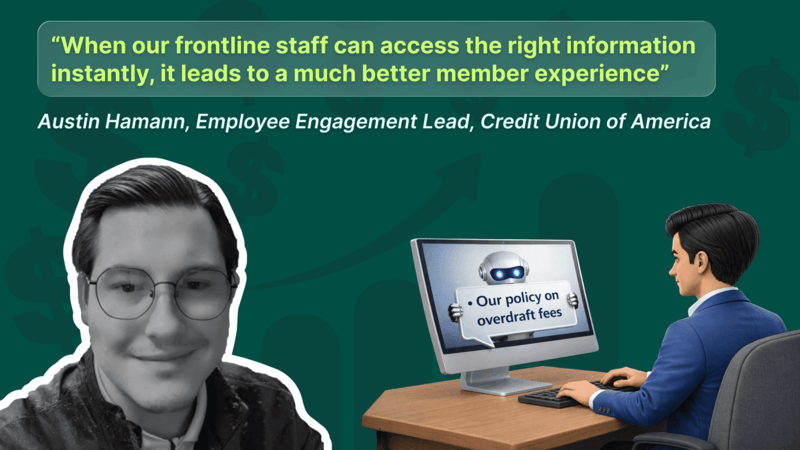
Frontline staff at $1.5B Credit Union of America were losing time and confidence during member interactions because critical documentation was scattered across network drives, shared folders, and intranet pages. When employees couldn’t find answers quickly, it created friction for members and frustration for staff — contributing to a member support turnover rate that once reached 90%.
Credit Union of America launched interface.ai’s Employee AI in late 2023 to fix this. Austin Hamann, Employee Engagement Lead, worked with departments across the organization to identify common questions and gather the documentation needed to support them. The team began with an alpha test involving frontline staff, asking real questions to identify knowledge gaps and refine responses before expanding department by department. The Credit Union also launched a monthly incentive program rewarding employees who used the system and submitted feedback.
The AI assistant pulled from internal documentation to deliver accurate answers in seconds, replacing the need to search multiple systems or escalate to colleagues. Employees now ask an average of 15-25 questions per day through the platform. Member satisfaction reached 4.73 out of 5. And agent turnover in the member support department dropped from 90% to 24%. (link)
2) First Heritage FCU fixes inconsistent, scattered knowledge
When frontline staff can’t find answers quickly, they ask the person next to them. At First Heritage Federal Credit Union, that habit was producing a different answer depending on who you asked.
Zach Saunders, Director of Retail Operations and Training, played a key role in testing and refining the rollout of their AI solution, the Knowledge Assistant from Posh. Before going institution-wide, the team stress-tested the system with extensive questions, using the AI’s interpretations to identify gaps and improve how internal procedures were written. The tool launched first in the contact center, then expanded across departments. Staff can now find answers much faster, helping reduce hold times and transfers for members.
First Heritage also deployed Posh Answers on its public website, giving the marketing team analytics into what members are actually searching for — visibility they had never had before. New hires are now onboarded with Knowledge Assistant from day one, and that group has become the most engaged users, pulling more seasoned employees along with them. With strong early results, the CU is preparing to roll out Workshop Mode, a generative AI workspace, to over 150 staff members. (link)
3) APL Federal Credit Union took the chaos out of a core conversion
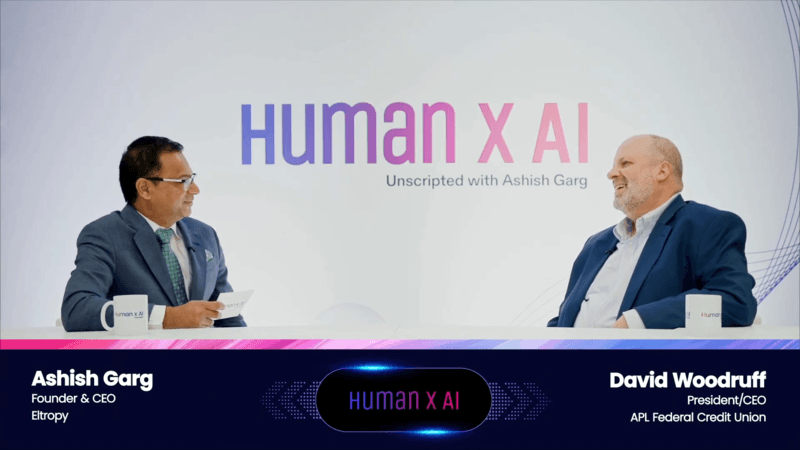
Core conversions are often treated as an all-hands emergency. Staff flood support lines, vendors send people on-site, and even simple questions like how to reverse a payment can slow down service.
$680M, 58-employee APL Federal Credit Union was planning to implement Eltropy’s Employee Assist after their conversion wrapped up. But a light bulb moment hit CEO David Woodruff: why wait? So the team loaded all their documentation into the platform before going live, giving staff a conversational tool to get instant answers during the transition. When the core vendor’s on-site support team arrived, they had almost nothing to do. APL’s staff were already getting answers through the AI assistant, in real time, without picking up the phone.
Woodruff sees this as the right model for AI in Credit Unions. Let the tech absorb the repetitive and procedural, so people can show up for the moments that actually require human judgment. He points to a $200 credit line extension for a single mom trying to get her daughter to Dover Air Force Base as the kind of decision that required human judgment and empathy. That’s where Credit Union staff need to be — not searching for a procedure in a folder somewhere. (link)

Tips & Use Cases
Learn to apply AI…
717 Credit Union uses AI decision engines to lend deeper: Dan Harp, Chief Lending Officer, says AI-powered decision engines now evaluate up to 2,000 variables per application, freeing underwriters from routine approvals to spend more time on complex, lower-credit-score borrowers who need a human review. The goal is fewer charge-offs through the engine, and more approvals through the human. (link)
FourLeaf CEO says tech is the biggest gap in member experience: Linda Armyn says the Credit Union is launching a new account opening system and evaluating a new loan origination system to close tech debt gaps and stay relevant with members. (link)
River Valley FCU taps Scienaptic AI for credit decisioning: The $60M South Arkansas Credit Union expects the platform to reduce manual processing, improve documentation consistency, and support responsible credit growth without adding complexity for members or staff. (link)
Vantage West CU builds AI-ready culture through experimentation: Rob Hoyle, Chief People & Technology Officer, says the CU is using AI across underwriting, member communications, and content creation, with an internal knowledge base in development. The goal is to serve 300,000 members with the same workforce that serves 210,000 today, by using AI to handle repetitive, recurring tasks. (link)
First New York FCU takes governance-first approach to AI adoption: CTO Justin Cresswell says they started their AI rollout by establishing governance and risk oversight before deploying any tools, using Microsoft Copilot as an early use case. The strategy focuses on identifying specific problems first, then bringing AI to the table rather than adopting tools and finding uses for them after. (link)
Survey finds FIs unprepared to manage vendor AI risk: A Ncontracts survey of 173 financial services professionals found that AI risk now ranks alongside cybersecurity as the top third-party concern. Yet 72% of respondents are only partially aware of which vendors are using AI. Nearly 63% of third-party risk programs run with just one or two staff members while overseeing 300 or more vendors. (link)
Santander and Visa complete agentic payments pilot in Latin America: The two companies completed a controlled pilot where AI agents autonomously purchased goods across Latin America using Visa Intelligent Commerce. The test validated consent capture, secure data handling, and cross-market interoperability. (link)
JPMorgan partners with Mirakl to enable agentic commerce: JPMorgan Payments is piloting a system where AI agents can browse merchant catalogs and complete purchases autonomously, combining JPMorgan’s payment infrastructure and fraud controls with Mirakl Nexus’s agentic commerce layer. A broader rollout is planned for later this year. (link)
PYMNTS report finds AI adoption plateauing at 49% of U.S. adults: Growth is now driven by existing users doing more rather than new users signing up, with power users averaging 27 AI-driven tasks per month across shopping, task management, and financial decisions. Over half of U.S. adults remain holdouts, including 72% of baby boomers. (link)
CU execs want AI use cases, not demos: Cornerstone Advisors reported that Credit Union executives at this year’s GAC described AI vendor pitches as “shiny object overload,” with leaders saying what they want most are practical use cases tied to specific business outcomes. Roughly 60% of CEOs are expected to retire within five years, adding urgency to AI strategy and succession planning simultaneously. (link)
AI agents accelerate processes but aren’t replacing jobs yet: Cornerstone Advisors argues that AI agents today are best understood as process accelerators that get work to the human faster, not replacements for human decision-making. Credit Unions against assuming “human-in-the-loop” means the agent does the work and a human approves it, that misunderstanding is leading institutions to underinvest in redesigning the underlying process. (link)
Goldman Sachs builds AI agents with Anthropic for back-office work: After embedding Anthropic engineers inside the firm for six months, Goldman Sachs deployed autonomous AI agents that compress week-long KYC compliance checks into automated document review and cut reconciliation from days to hours. Their CIO describes the result as a “digital coworker” for complex, process-intensive roles. (link)
Claude’s new visual reasoning tool aids financial decision-making: Anthropic’s Claude can now read uploaded financial statements and generate interactive visualizations, scenario models, and board-ready analysis within a single chat session. A CFO Office test showed Claude building three capital allocation scenarios from a P&L without being prompted to do so. (link)
Gemini in Google Sheets struggles with complex finance workflows: Google shipped a major Gemini update for Sheets in March, claiming 70% success on spreadsheet benchmarks. But real-world testing on a multi-file rolling forecast workflow showed the tool failing to reliably move data across Gmail, Drive, and Sheets in one flow, a capability Claude Cowork handled more reliably. (link)
Commerzbank deploys Hawk AI to boost AML detection accuracy: The bank layered Hawk’s AI-driven risk model on top of its existing rule-based compliance systems, reducing false positive alerts while detecting more novel money laundering cases. The solution integrates with legacy systems without requiring technology overhauls. (link)
AI ROI requires work redesign, not just tool deployment: Globant’s Financial Services AI Studio CEO argues that AI stalls when layered onto unchanged workflows without redefining accountability. The fix is explicitly separating what AI executes from what humans decide, then measuring results in cycle time and cost-to-serve rather than training completions. (link)
AI tools are pulling small businesses away from bank portals: More than 70% of small businesses now regularly use AI tools for cash flow forecasting, payment tracking, and financial reporting, often bypassing their bank’s platform entirely by exporting data into external AI tools. (link)

Funding Spotlight
Where the money is flowing for innovation…
Uptiq raises $25M Series B with investment from Curql: Curql, the investment fund backed by over 160 Credit Unions, participated in the round to scale Uptiq’s AI platform across lending, member servicing, compliance, and operational workflows. The funding will expand access to Qore, Uptiq’s AI orchestration platform for building and deploying financial workflows inside Credit Union core systems. (link)
Gangkhar raises $4.25M Seed to expand AI-native embedded protection platform: Gangkhar’s AI optimization engine uses real-time program data to improve segmentation, pricing, and underwriting across embedded protection products in multiple markets. The capital will fund product development and international expansion via its single-API infrastructure covering onboarding, pricing, underwriting, and claims. (link)
Onyx Security launches with $40M to govern AI agents in enterprise: The platform monitors AI agents in real time and can approve, modify, or block their actions before they execute, helping enterprises enforce governance policies as autonomous AI systems gain access to critical infrastructure. (link)
BrightPlan secures new funding to expand AI financial wellness platform: The platform serves 9.2M employees across 50+ countries, combining AI-driven guidance with live advisors, and posted 41% YoY recurring revenue growth. Funding will support global expansion and accelerated AI personalization across the platform. (link)
Armadin raises $189.9M to build autonomous AI cyber defense: The platform uses a network of AI agents that continuously probe an organization’s infrastructure for real-world exploit paths, moving at machine speed to outpace AI-driven attacks. (link)

Keeping up with Tech
The latest in fintech and tools…
Posh launches CoachQA to evaluate 100% of contact center interactions: Most Credit Union QA teams review less than 1% of calls, leaving compliance gaps, fraud signals, and coaching opportunities invisible. CoachQA automatically applies each institution’s SOPs to every interaction, with Citadel Credit Union and Chartway Credit Union among early adopters. (link)
Glia announces no hallucination guarantee for its banking AI platform: Glia’s proprietary approvals framework separates AI’s ability to interpret customer intent from the system that generates responses, preventing the AI from improvising answers in real time. The contractual guarantee covers hallucinations and prompt injection attacks across Glia’s platform. (link)
Napier AI launches Insights AI for AML investigations: The tool surfaces AI-driven explanations of customer behavior directly within transaction monitoring tasks, cutting manual analysis for compliance teams. It was developed using novel frequency-based algorithms tested in the FCA’s Supercharged Sandbox. (link)
Agora launches Orbit AI operating system for financial advisors: The platform runs continuously in the background, automating routine processes and surfacing only moments requiring advisor judgment or client engagement. (link)
OpenAI shifts AI checkout to third-party partners: Rather than embedding purchases directly in ChatGPT, OpenAI is routing transactions through third-party e-commerce partners to prove the agentic commerce model before the 2026 holiday retail freeze. (link)
Experian launches credit score tool inside ChatGPT: The app uses aggregated Experian data to show how credit scores compare by postcode and age group, with a direct route to check a personalized score. The move targets 18-34-year-olds, who make up more than half of ChatGPT’s user base but are among the least likely to have checked their credit score. (link)
Perplexity expands Computer platform with finance and enterprise tools: The platform now connects to brokerage accounts via Plaid for portfolio analytics, pulls live data from SEC filings, FactSet, S&P Global, and other sources, and can build Excel models and financial dashboards without additional licenses. An enterprise version integrates with Snowflake, Salesforce, and Slack for cross-platform financial analysis. (link)
Sutherland launches FinAI Hub for banking AI workflows: Modular AI agents cover KYC, AML, underwriting, fraud, disputes, and collections, designed to integrate with legacy systems in regulated environments. Early deployments reported up to 50% faster processing cycles and 40% reductions in operating costs. (link)
OpenAI equips Responses API with a computer environment for agents: Developers can now give AI agents a hosted container with a file system, database access, and controlled network access. A single prompt can trigger end-to-end workflows like fetching live data and generating a spreadsheet. (link)

In Other News
Related news you can learn from…
No single solution can fully verify Deepfakes (link)
AI is raising a new question: who should control powerful tech? (link)
AI agents are facing a new wave of social engineering-style attacks (link)
Bilt faces growing backlash as AI support and payments issues frustrate users (link)

Community Corner
Memes and visuals…


Thanks for reading!
Until next week,
— Credit Union AI Guy
Enjoying this newsletter? Forward it to a colleague who might appreciate practical AI insights.
Have a question or want to share your own AI experiment? Reply to this email or connect with us on LinkedIn. We’re building a community of curious Credit Union professionals. Come join the conversation!