


When the work doubles, does your headcount have to?
Not if you hand the repetitive work to AI and keep your people on what matters.
This week, I cover:
Great Basin FCU grows funded auto loans 187%
Natco CU cuts phone hold times 66%
LMCU cuts a 150-step HMDA process to 15
Read time: 8 minutes

Top Stories
The biggest news this week…
1) Great Basin FCU grows funded auto loans 187%
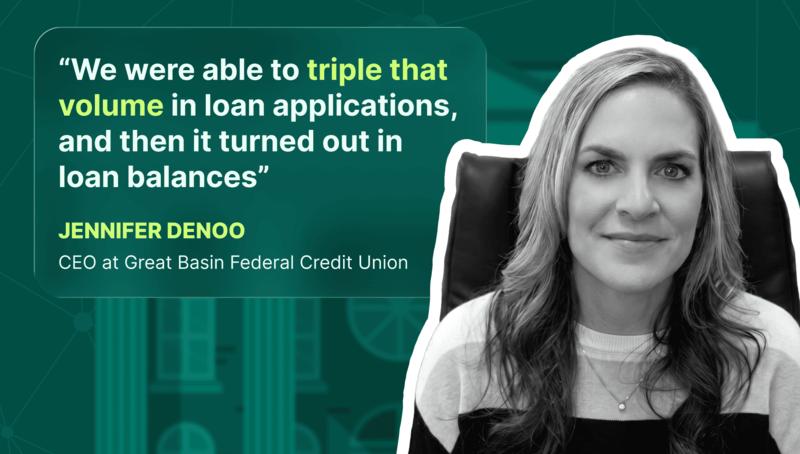
Great Basin Federal Credit Union wanted to expand from one county into 10 more, including three in another state, without hiring to handle the volume. Scaling into new markets usually means adding underwriting staff and a data analyst, which dents the bottom line.
CEO Jennifer Denoo needed a way to grow lending without growing overhead. So, Denoo chose Zest AI’s underwriting suite to automate loan approvals. The $354M Credit Union also added LuLu, Zest’s generative AI lending intelligence companion.
Denoo’s team treats LuLu like an on-demand data analyst. When delinquencies saw an uptick, she asked LuLu to compare her spreads against peers. LuLu pushed her to widen the peer group to plus or minus 20% of asset size. That wider lens revealed Great Basin was outperforming peers by nearly 100 basis points.
Over two years, the Credit Union processed 165% more auto loan applications without adding a single team member. Approval ratios stayed consistent. Funded auto loans climbed from $23M to $66M. The icing on the cake: Annual interest revenue rose 146%, thanks to the expansion supported by Zest AI. Denoo says the partnership let her avoid two hires, an underwriter for the loan volume and a data analyst for strategic decisions. (link)
2) Natco CU cuts phone hold times 66%
Members calling Natco with urgent money problems could sit on hold for up to an hour, sometimes losing their place to someone who just dialed in. Calls held past three minutes dropped into a backup queue with no order by wait time. A member waiting 45 minutes could get leapfrogged by a new caller. Managers had no live visibility and could only react after issues escalated.
Natco Credit Union rebuilt its contact center with Eltropy Voice+. Branch Operations Manager Clarissa Rice’s team moved every call into a fair first-in, first-out queue with scheduled callback options. Managers gained live dashboards, whisper coaching to guide agents mid-call, and barge-in support to step into escalations. When a member calls the loan department, Voice+ now sends a contextual text with self-service links during the call.
Average hold time dropped 66% and became predictable for the first time. Natco answered more than 6,200 additional calls without adding complexity for staff. Collections performance improved as callback delays and back-and-forth disappeared. (link)
3) Lake Michigan CU cuts a 150-step HMDA process to 15
Manual compliance processes eat hundreds of staff hours every year. When a single workflow has 150 steps, errors pile up, and audits become a constant source of stress. Lake Michigan Credit Union, a $17B institution and the 13th largest Credit Union in the U.S., decided to fix the problem at its root. CIO Chris Ortega found a typical IT environment that needed stabilization, modernization, and more transparency with the business side.
Before deploying any AI tools, Ortega restructured how the organization operates. He built a Center of Excellence and an Emerging Technology Governance Board that owns AI, RPA, and stablecoins under one committee. The team operates on what Ortega calls the “3 C’s”: collaborative heart, curious minds, and continuous excellence. One governance board handles all emerging technology to prevent siloed committees, duplicated spend, and conflicting priorities.
The signature win was HMDA reporting. Beth Baird, who runs the Center of Excellence, mapped the process and cut it from ~150 steps to 15 using agentic AI and automation. “I was blown away,” Ortega said. “Almost brought a tear to my eye. How many times can you take a hundred-step process and take it down to something like 10?”
The Credit Union is now applying the same approach to mortgage and lending, call center operations, fraud detection, and auditing. Ortega is deliberate about cost discipline, tracking token usage and ROI through dashboards to ensure AI investments pay for themselves. Staff adoption includes AI bootcamps, lunch and learns, and Co-Pilot licenses across the organization. (link)

Tips & Use Cases
Learn to apply AI…
P1FCU goes all in on AI in its call center: The Credit Union used Eltropy to route members to the right agents automatically, freeing staff from routine questions and transfers. Agents now spend their time on complex issues instead of basic inquiries. P1FCU measures success through abandon rate, member sentiment, and call time, all improving with the same headcount. (link)
UKFCU targets 40% auto-decisioned loans with AI: The $1.75B FCU went live with Zest AI on home equity and auto loans to approve more members without adding risk. The goal is 40% of consumer loans decisioned by AI within year one. UKFCU also launched Glia’s virtual assistant in its call center, aiming to handle 60% of calls without a rep and cut after-hours support costs by 70%. (link)
AI now decides which banks get recommended first: EMARKETER’s new AI Visibility Index tracks which financial brands appear most in ChatGPT responses across nine categories. Capital One, PayPal, and Coinbase lead by using clear positioning and strong customer satisfaction signals. Credit Unions can start by owning a specific category and describing products the way members actually search. (link)
How AI turns relationship managers into data-activated experts: For Credit Unions sitting on siloed data, combining AI with existing client activity can arm calling officers with insights no competitor is offering. (link)
Only 28% use bank AI assistants, but satisfaction rises: JD Power found only 28% of bank and credit card app customers use virtual assistants, but users report 18 points higher satisfaction when the tools feel comprehensive. The biggest AI gap is complex service like disputes, fraud, and escalation to human support. (link)
1.6% of work activities drive 60% of AI’s value: MIT researchers found AI is concentrated in information work, with 72% of AI market value tied to information-based tasks. AI’s biggest near-term impact will likely hit knowledge-heavy CU workflows first, including reporting, underwriting, and compliance reviews. (link)
Cornerstone Advisors says most AI workflows waste tokens: Judd Heckman and John Meyer warn organizations are burning AI tokens on repetitive tasks that should be built into deterministic systems. They recommend asking vendors whether workflows can run without an LLM at every step and whether AI is used selectively. (link)
NatWest uses AI to speed trade finance checks: NatWest is working with Cleareye.ai to extract and classify data from complex trade documents across digital and paper formats. ClearTrade will also run automated compliance and trade-based money laundering checks under ICC rules. (link)
CommBank tests AI companion for money management: CommBank is testing an in-app AI companion that uses live banking data to answer questions about spending, savings, subscriptions, and budgeting. The tool is being piloted with employees and select business banking customers before a wider rollout. (link)
22% of consumers already use AI for finances: MX research found 58% would trust AI for proactive reminders like bill payments and savings. The problem: most Credit Unions have fragmented, siloed data that AI tools can’t use effectively. Clean, unified first-party data is what separates institutions that can build useful AI experiences from those that watch members find answers elsewhere. (link)
Tax AI saved accountants one-third of prep time: OpenAI and Thrive Holdings built Tax AI for Crete’s 30+ accounting firms, processing 7,000 tax returns with up to 97% accuracy. One senior accountant cut tax prep from 180 hours last year to 15 hours this year. (link)
75% of SMBs want AI tools from their FI: PYMNTS and Velera found 75% of SMBs and 59% of consumers would use at least one AI assistant feature from their financial institution. Meanwhile, only 25% of Credit Unions currently offer AI chat support. (link)
Citi cuts account opening review from 60 to 15 minutes: An AI document-processing system now handles material review for new accounts in the bank’s U.S. services division. Citi is also using AI to automate coding, testing, and data migration off legacy systems. The bank has flagged 50 internal processes for automation, starting with client onboarding and KYC compliance. (link)
39% of lenders now use AI in loan originations: A Celent survey of 106 lenders found another 36% are building AI into originations right now. The biggest barrier: 68% say their loan origination systems can’t integrate with external data and decisioning tools. (link)
PayPal, Chase and Klarna show finance has no single AI playbook: PayPal is partnering with Anthropic to help SMBs adopt AI inside daily workflows. Chase is still investing in branches while Klarna is making payments more habitual through BNPL and recurring engagement. (link)
1 in 5 bankers unsure how AI affects commercial lending: Cornerstone Advisors found that across every stage of commercial lending, roughly 20% of respondents couldn’t say what impact AI would have. Another 20% expect strong results like 20%+ cost cuts and faster cycle times, especially in underwriting, due diligence, and post-closing. (link)
AI coding tools can speed up Credit Union website updates: Cursor, GitHub Copilot, and Claude can generate working prototypes from plain descriptions and flag accessibility or performance issues. One Credit Union used Cursor to cut load times on a rates page. Start on non-critical pages and scan all output for security flaws before anything goes live. (link)
JPMorgan has 1,000 AI use cases underway: Jamie Dimon said JPMorgan has about 1,000 AI use cases in progress, with 50 to 60 considered significant, and the bank is already “saving real money.” It is beta-testing Smart Cash, an AI tool that moves customer funds between checking and higher-yield brokerage products. (link)
Intuit cuts 3,000 jobs as AI investment accelerates: Intuit is cutting about 17% of its workforce while closing offices in Reno and Woodland Hills as it shifts resources into generative AI. The TurboTax maker has multi-year deals with Anthropic and OpenAI and is embedding tax capabilities into AI assistants. (link)

Funding Spotlight
Where the money is flowing for innovation…
Anthropic raises $65B Series H at $965B valuation: Anthropic said Claude revenue hit a $47B run rate, with funding aimed at safety research, compute expansion, and scaling Claude Code and Cowork. (link)
Bayshore raises $8M seed to automate compliance with AI agents: The Munich-based RegTech converts legal and compliance rules into machine-readable code that AI agents can act on, auto-approving lower-risk cases and escalating complex ones to humans. Multiple Global 2000 firms already use the platform. (link)
Daloopa raises $47M Series C to power AI-ready financial data: The platform delivers structured, source-linked data on 5,500+ public companies, giving AI tools the accuracy and traceability that web-scraped data lacks. Daloopa doubled revenue over the past year. (link)
Gray Swan raises $40M Series A for enterprise AI security: The Carnegie Mellon spinout evaluates frontier AI models for Anthropic, OpenAI, and Meta before public release. Its platform detects prompt injection, jailbreaks, and data exfiltration in real time across production AI deployments. (link)
Geordie AI raises $30M Series A for AI agent security: The platform gives enterprises real-time visibility into which AI agents are running, what they can access, and what risks they introduce. Geordie reported 1,300% ARR growth in the first five months of 2026. (link)
Payslip raises funding to expand AI payroll platform: Payslip already processes 1.3M+ payslips monthly across 125+ countries. Its AI suite delivers up to 55% efficiency gains by identifying anomalies and standardizing inputs across jurisdictions. (link)
Gradient Labs doubles Series A to $26M for autonomous finance agents: Founded by Monzo alumni, the startup builds AI agents that handle collections, disputes, and KYB checks end to end. Revenue grew 900% last year, with agents now reaching 32M+ end users across Wise, Monzo, and Current. (link)

Keeping up with Tech
The latest in fintech and tools…
Ramp launches AI operating system for accounting firms: Ramp Stack marks the company’s entry into the accounting software market with an AI-native platform. The system aims to automate accounting workflows across expense management, bookkeeping, and financial operations. (link)
Anthropic releases Claude Opus 4.8 with dynamic workflows: Anthropic released Claude Opus 4.8 with stronger coding, agentic tasks, and better honesty (4x less likely to let code flaws pass unremarked). New features include dynamic workflows for hundreds of parallel subagents and effort control for users. (link)
Meta’s $14.3B AI push brings advice into social apps: Meta released Muse Spark, a multimodal AI model that will power Meta AI across Facebook, Instagram, WhatsApp, Messenger, and Ray-Ban Meta glasses. The model supports text, image, video, tool use, and multi-agent coordination. (link)
Extend hit 99.2% accuracy on long document extraction: Extend’s LongArray-Extract benchmark tested 45 PDFs with long repeated records, achieving 100% completion and 99.2% accuracy. It outperformed Reducto Deep Extract at 97.4% and Claude Opus 4.7 at 83.1%. (link)
OpenAI gives UK banks access to cyber AI: OpenAI is giving Lloyds, HSBC, and Nationwide access to GPT-5.5 Cyber. The move contrasts with Anthropic, which has kept Mythos limited mostly to U.S. firms. (link)
Fiserv “hires” Devin to speed core modernization: Fiserv is deploying Cognition’s AI software-engineering agent across core platform modernization and strategic engineering work. Devin can understand complex codebases, write and test code, and iterate autonomously. (link)
Farsight turns deal materials into one-prompt workflows: Farsight launched Freeform, an AI agent that creates client-ready pitch decks, CIMs, investment memos, and financial models from transcripts and prior deal documents. The agent generates firm-standard outputs with less post-production editing. (link)
OpenAI brings Codex and frontier models into AWS: OpenAI models and Codex are now available on AWS through Amazon Bedrock, including Commercial and GovCloud regions. Codex is used by more than 5M people weekly for writing, reviewing, and debugging code. (link)
Robinhood lets AI agents trade and spend: Robinhood users can now open dedicated agentic trading accounts where AI agents trade only with funds in that separate account. Users can also connect agents to a virtual Robinhood Gold Card with spending limits and manual approvals. (link)

In Other News
Related news you can learn from…
AI can turn patches into attacks in 30 minutes (link)
$3T AI credit boom could test bank risk controls (link)
Credit Union AI fails without a strong IT foundation (link)
Altman says AI job apocalypse hasn’t happened yet (link)
2021 infrastructure contracts may not survive AI exams (link)
B2B payments could hit $224T as stablecoins power AI agents (link)
ChatGPT could become the first stop for money questions (link)
$1T-a-year AI buildout raises financial advice risks (link)

Community Corner
Memes and visuals…

Thanks for reading!
Until next week,
— Credit Union AI Guy
Enjoying this newsletter? Forward it to a colleague who might appreciate practical AI insights.
Have a question or want to share your own AI experiment? Reply to this email or connect with us on LinkedIn. We’re building a community of curious Credit Union professionals. Come join the conversation!