


Your contact center is one of the most underrated AI opportunities in your Credit Union right now.
Not for cutting headcount, but for enhancing staff to do the work that builds lifetime members.
This week, I cover:
GreenState Credit Union scores 13-minute calls in 30 seconds with AI
Navy Federal is layering AI into its digital interface for members and staff
4Front CU uncovers hidden training problem after 70% call containment
Read time: 9 minutes

Top Stories
The biggest news this week…
1) GreenState Credit Union scores 13-minute calls in 30 seconds with AI
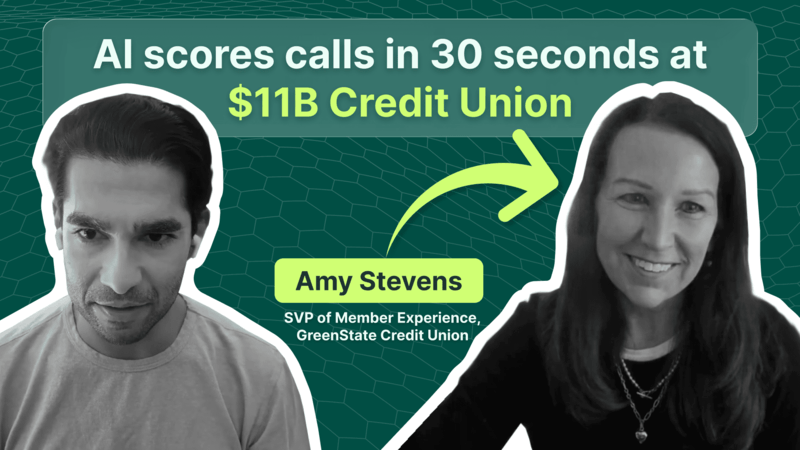
Once upon a time, GreenState Credit Union could only listen to a fraction of their call center volume, making quality scores statistically questionable guesses. Today, Amy Stevens, SVP of Member Experience at the $11B Credit Union, says AI quality management tools can now read transcripts and score a 13-minute call in 30 seconds. The system spots coaching opportunities across individuals and entire departments, flagging whether the gap is soft skills or technical system knowledge.
That was the first quick win, but GreenState has kept building. The Credit Union added real-time sentiment analysis in the contact center so agents and supervisors can see whether a member is green, amber, or red mid-call and adjust accordingly. Agents now get validated when they turn a red call into a green ending, reinforcing the behavior the Credit Union wants to scale.
Last week, GreenState launched voice biometrics for member authentication, cutting down the interrogation-style verification that drags on call times and frustrates members. Stevens frames it as both a security and an experience play. Because nobody wants to be interrogated before they can ask about their account.
On the roadmap is full agentic AI handling low-risk, high-volume transactions like CD renewals and loan payoffs inside the phone and chat channels. For now, the Credit Union uses a crawl-walk-run approach where the AI opens a case in Salesforce so a human completes the final step. Stevens says chatbots are actually easier to deploy than phone agents because the knowledge base already exists on the website, and the member demographic using chat expects self-service.
Stevens says AI frees agents to skill up into things like leadership development, escrow expertise, mortgage conversations, and higher-risk transactions. Employee engagement improves as work becomes more meaningful, and volumes shift toward AI agents, allowing the human team to focus on consultative sales and complex problem-solving. (link)
2) Navy Federal is layering AI into its digital interface for members and staff
When 10M members log in 27 times a month from every corner of the globe, your 24/7 contact center staff needs to see exactly what the member sees. Meghan Gound, SVP of Digital at Navy Federal Credit Union, says the world’s largest Credit Union built a single omnichannel interface that team members and members share. Contact center agents see exactly what the member sees, making it easier to navigate accounts and answer questions without toggling between systems.
Navy Federal is working on layering AI on top of that shared interface through context-aware insights. The system reads member transactions and activity to surface relevant information in the moment, whether that is a different account type or a product the member might need. Gound says the goal is to give staff and members the right information at the right time without making them go find it.
Navy Federal is taking a human-in-the-loop approach to AI. Members know when they’re interacting with AI, and team members monitor every decision point. The 5-year vision is to move digital from transactional to conversational, where the lines between channels blur and members can move fluidly between AI and human support. (link)
3) 4Front CU uncovers hidden training problem after 70% call containment with AI
Most Credit Unions know when call volume is too high. Fewer realize their training model is broken too.
4Front Credit Union was running a traditional IVR that routed overflow calls to branches. It worked for a smaller institution, but it wasn’t built for 4Front’s future. Chief Experience Officer Luis Pardo brought in Posh Voice, and members now know the AI agent as Penny. The Credit Union now holds a 70% voice containment rate, and NPS scores are at their highest point. Pardo says Penny made the contact center smarter about why members call in the first place, giving staff insights into common questions and how to answer them better. 4Front also deployed Posh Answers on the web to handle low-complexity, low-emotion needs through digital self-service. Pardo’s philosophy: self-service tools handle the routine stuff, and humans show up for the high-complexity, high-emotion conversations.
Later, the Posh team proposed a 30-day proof of concept for a Training Simulator. Pardo says it contradicts his own philosophy of always defining the problem before buying a solution. But he agreed to try it anyway. What it uncovered surprised him: Staff don’t want to practice difficult conversations with other humans. They prefer sitting down privately and running a scenario over and over until they get it right.
The timing was perfect because 4Front was in the middle of a training overhaul, reorganizing so contact center and branch hires got the same consistent onboarding instead of being trained by different people with different approaches. The simulator fit directly into that vision. New hires could practice independently during high-volume periods when senior agents couldn’t step away to coach without cutting their own productivity.
4Front built scenarios around the moments that define member relationships, like fraud calls and identity theft. A new hire can practice developing natural empathy before ever speaking with a real member during a sensitive situation. Pardo says those are the moments where Credit Unions can build memberships for a lifetime. (link)

Tips & Use Cases
Learn to apply AI…
How Credit Unions can run AI ads without wasting half the budget: Synter CEO Joel Horwitz says 20% to 40% of digital ad spend gets lost to bot traffic and low-quality impressions because AI writes strategy but can’t execute it. The fix is connecting AI to execution infrastructure with geographic exclusions, frequency caps, and CRM suppression lists enforced at the campaign level. (link)
Delfi brings on-demand AI balance sheet simulations to Credit Unions: CEO Daniel Ahn says Credit Unions can now run full what-if scenarios on pricing, hedging, loan participations, and M&A strategies in about 15 minutes for roughly $150 per run. That replaces weeks of waiting on ALM consultants and $75K to $100K in annual reporting costs. One Washington Financial formed a CUSO to bring Delfi to the Credit Union market. (link)
Corporate Central CU launching AI-built website in May: AI tools let Credit Union teams describe what they want and review structured changes before publishing, cutting long build cycles for landing pages, product launches, and campaign pages. The key is governance through clear publishing controls, brand guardrails, and defined approval workflows. (link)
Workers Credit Union rolls out AI to boost FTE productivity: Workers CU created a board-approved AI governance policy before running any pilots. Small pilots focused on employee productivity, not headcount cuts, freeing staff from back-office tasks (link)
Informed IQ flags fake loan docs with 99% confidence: Auto loan application fraud jumped 24% last year, per TransUnion, with fraudsters using AI to generate fake pay stubs and utility bills that pass human review. Industry fraud rates run 3% to 4% on unfunded deals, with some Credit Unions seeing 7% to 8% on funded deals. Informed IQ catches misrepresentation in real time, shows the redacted document so staff can have transparent member conversations, and integrates with Origence, MeridianLink, and Defi. (link)
How Fuse pairs AI loan origination with automation coaching: Co-founder Andres Klaric says implementation time is dropping from 3-4 months to 30-60 days as an AI-native architecture speeds deployment. The platform includes automation coaches who meet with lenders every two weeks to pinpoint funnel gaps and improve efficiency. One client hit its highest-volume month right after launch with no new hires. (link)
Primitive helps community bank collapse commercial lending to 30 seconds: A 700-employee bank deployed three AI agents to compress an eight-stage, 12-person commercial lending process with seven governance gates from 45 days down to 30 seconds. Humans stay in the loop and can stretch decisions over three days if preferred, freeing bankers to focus on relationships and revenue. (link)
Fifth Third uses AI to pressure-test marketing before launch: EVP and CMO Melissa Stevens says about half the bank’s workforce uses Copilot daily. Her team uses GenAI to build brief templates, refine draft messaging, evaluate tone, and recut previously produced commercials, asking AI things like “How will this land?” against external data and internal research. (link)
$16B community bank reinvests AI call center savings into staff development: After deploying Glia’s AI to handle 60% of call volume, the bank absorbed 8 FTEs through natural attrition, cut abandonment 72%, and saved $198K in outsourced overflow and interpreter costs. Managers now use the freed-up time to coach agents and build career development programs instead of backfilling roles. (link)
Anthropic surveys 80,000 AI users across 159 countries: The largest qualitative AI study found that optimism and concern often coexist within the same person. Users call AI a “thought partner” for tasks like contract review and problem-solving, but worry about incorrect results, job displacement, and skill erosion from overreliance. (link)
Community banks say clean data is the real AI bottleneck: Vantage Bank’s Shawn Main told an American Banker panel that AI is “garbage in, garbage out” without a solid data lake, and most community lenders have not built that skill yet. Passumpsic Bank CEO Jim Kisch says getting data right frees staff for new roles like fraud grief counselors and small business advisors. (link)
Survey finds most banks can’t measure their own AI fluency: American Banker polled 206 banking professionals, and only 16% rated their institution’s AI literacy as high or very high. Most called it moderate, but when asked how they measured, answers ranged from “educated guess” to “ad hoc” to “nothing definitive yet.” National banks rated themselves high at 26% compared to 4% at community lenders under $10B. (link)
Customers Bank deploys OpenAI across commercial lending and payments: The $26B regional bank says 75% of its staff already uses OpenAI-powered tools daily. Now they’re partnering directly with OpenAI to re-engineer lending, deposit, and payment workflows, and rolling out AI agents from ElevenLabs for call center coaching, onboarding, and 24/7 voice and chat support. (link)
Citi Wealth launches AI avatar to advise clients in real time: Citi partnered with Google Cloud and Google DeepMind to build Citi Sky, an always-on AI team member that helps Citigold clients with CD maturity events and market insights through natural voice conversations. It’s launching in English and Spanish using Google’s Gemini Enterprise Agent platform and will roll out across Citi Wealth platforms in the U.S. (link)

Funding Spotlight
Where the money is flowing for innovation…
Monk raises $25M Series A to automate accounts receivable with AI: The platform deploys AI across the full contract-to-cash lifecycle, delivering a 40% reduction in days sales outstanding and 25+ hours saved per month for AR teams. (link)
Petual raises $20M to automate SOX compliance with AI: Agentic AI generates auditor-ready work papers from screenshots, PDFs, and Excel files in minutes instead of hundreds of hours. Early clients include S&P 500 and NASDAQ 100 companies, seeing 68% to 80% efficiency gains on existing SOX workflows. (link)
Cloudsmith raises $72M Series C to govern AI-generated code: As AI coding agents produce software faster than humans can review it, enterprises face an expanding attack surface across open-source libraries and third-party dependencies. Cloudsmith gives engineering teams visibility and control over every package at every stage, with Fortune 500 and Global 2000 companies already on the platform. (link)
NOVAPRO closes seed round to scale AI stock analysis platform: Tokyo-based NOVAPRO is building EasyAlpha.pro, which uses proprietary machine learning models to deliver institutional-grade stock analytics and investor education tools. (link)

Keeping up with Tech
The latest in fintech and tools…
OpenAI rolls out GPT-5.5 with stronger agentic coding and finance tools: The model scores 88.5% on internal investment banking modeling tasks and 60% on FinanceAgent, while using fewer tokens to complete the same work. OpenAI says 85% of its own staff now uses Codex weekly, with one finance team reviewing 24,771 K-1 tax forms across 71,637 pages two weeks faster than the prior year. (link)
OpenAI introduces workspace agents for team workflows in ChatGPT: Powered by Codex, these shared agents handle long-running tasks like preparing reports, qualifying leads, and drafting follow-ups across tools, running in the cloud even when users are offline. Teams describe a repeating workflow, and ChatGPT builds the agent step by step. Available now in Business, Enterprise, and Edu plans. (link)
Microsoft embeds Moody’s credit intelligence into Copilot: Financial professionals can now access Moody’s credit ratings, research, and entity data directly inside Microsoft 365 Copilot, Excel, and Copilot Chat without custom integrations. The data layer spans 600 million entities and 2 billion ownership links, extending credit context beyond specialists to anyone across an organization who needs it. (link)
Backbase launches AI-native Banking OS for frontline operations: The system sits above existing cores, payments, and CRM without replacing them, giving customers, employees, and AI agents one shared view of every interaction. Backbase estimates 80% of frontline banking work happens in the gaps between systems. Navy Federal is among its 120+ deployments across 50 countries. (link)
Aurionpro launches AI-native trade finance platform Fintra: Specialized AI agents handle document processing, compliance screening, and risk scoring in a workflow where the ICC estimates a 70% first-presentation rejection rate. Every decision runs through a confidence-gated protocol that routes to a human based on materiality and regulatory mandate before executing. (link)
Savvy Wealth debuts AI agents for independent financial advisors: Savvy Intelligence unifies investment, tax, and planning data into one household-level view, then lets advisors run thousands of what-if scenarios with results on a live interactive canvas in minutes. The firm now manages nearly $6B in client assets, 5x what it held a year ago, and estimates advisors spend 70% of their time on work that is not client-facing. (link)
Ballerine ships AI merchant fraud detection in under 60 seconds: The platform analyzes digital footprints, ownership structures, and behavioral signals across merchant networks to catch coordinated scam operations before transactions occur. Former Visa Head of Ecosystem Risk Cihat Fitzgerald, now Ballerine’s CRO, says fraud has become structured and designed to move across acquirers and geographies at scale. (link)
Alipay launches payment processing for AI agent transactions: Businesses can now onboard monetizable services and get paid automatically when autonomous AI agents purchase on behalf of users. Bocha, an AI search tool powering 30M daily API calls for DeepSeek, already uses the product to sell pay-per-use web search through AI agents. Alipay’s consumer-facing AI Pay product crossed 100M users and 120M weekly transactions in February. (link)
Prophix deploys AI agents to cut finance team cycle times: New agents inside the Prophix One platform turn customer data into validated FP&A models in hours instead of weeks and deliver role-based financial intelligence directly inside Microsoft Teams. A consolidation agent coming this spring lets teams query audit trail data in plain language to spot unusual balances on demand. (link)
OpenAI releases open-weight model for masking personal data in text: Privacy Filter detects and redacts names, addresses, phone numbers, account numbers, and API keys in a single pass across up to 128,000 tokens of context. The 1.5B-parameter model runs locally, so sensitive data never leaves the machine, and it scores 97.4% F1 on the PII-Masking-300k benchmark. Available now under Apache 2.0 on Hugging Face. (link)
xAI recruits Wall Street talent to train Grok on financial reasoning: Elon Musk’s AI startup is hiring bankers, portfolio managers, traders, and credit analysts to teach its chatbot how to reason through leveraged loan syndication and collateralized loan obligations. OpenAI and Anthropic have already shipped financial analysis tools, and xAI is seen as trailing rivals in attracting enterprise clients. (link)

In Other News
Related news you can learn from…
The real risk of AI becoming a go-to source for financial advice (link)
Coinbase intros agentic AI transactions with security guardrails (link)
AI is lowering the barrier to fraud and expanding the threat landscape (link)
Human content is becoming a competitive advantage in the AI search era (link)
Ron Shevlin breaks down stablecoin risk across 3 layers community banks miss (link)

Community Corner
Memes and visuals…

Thanks for reading!
Until next week,
— Credit Union AI Guy
Enjoying this newsletter? Forward it to a colleague who might appreciate practical AI insights.
Have a question or want to share your own AI experiment? Reply to this email or connect with us on LinkedIn. We’re building a community of curious Credit Union professionals. Come join the conversation!