


The gap between Credit Unions using AI and those watching from the sidelines is getting harder to ignore.
Some new data is in, and it’s pretty clear: The financial institutions spending more on AI are the ones seeing the biggest gains.
This week, I cover:
ELGA Credit Union drives $5.7M in new auto loans with AI targeting in 30 days
American Banker’s 2026 AI Talent Shift Survey reveals where Credit Unions stand
Texas Tech FCU cuts response times 50% with voice AI
Read time: 9 minutes

Top Stories
The biggest news this week…
1) ELGA Credit Union drives $5.7M in new auto loans with AI targeting in 30 days
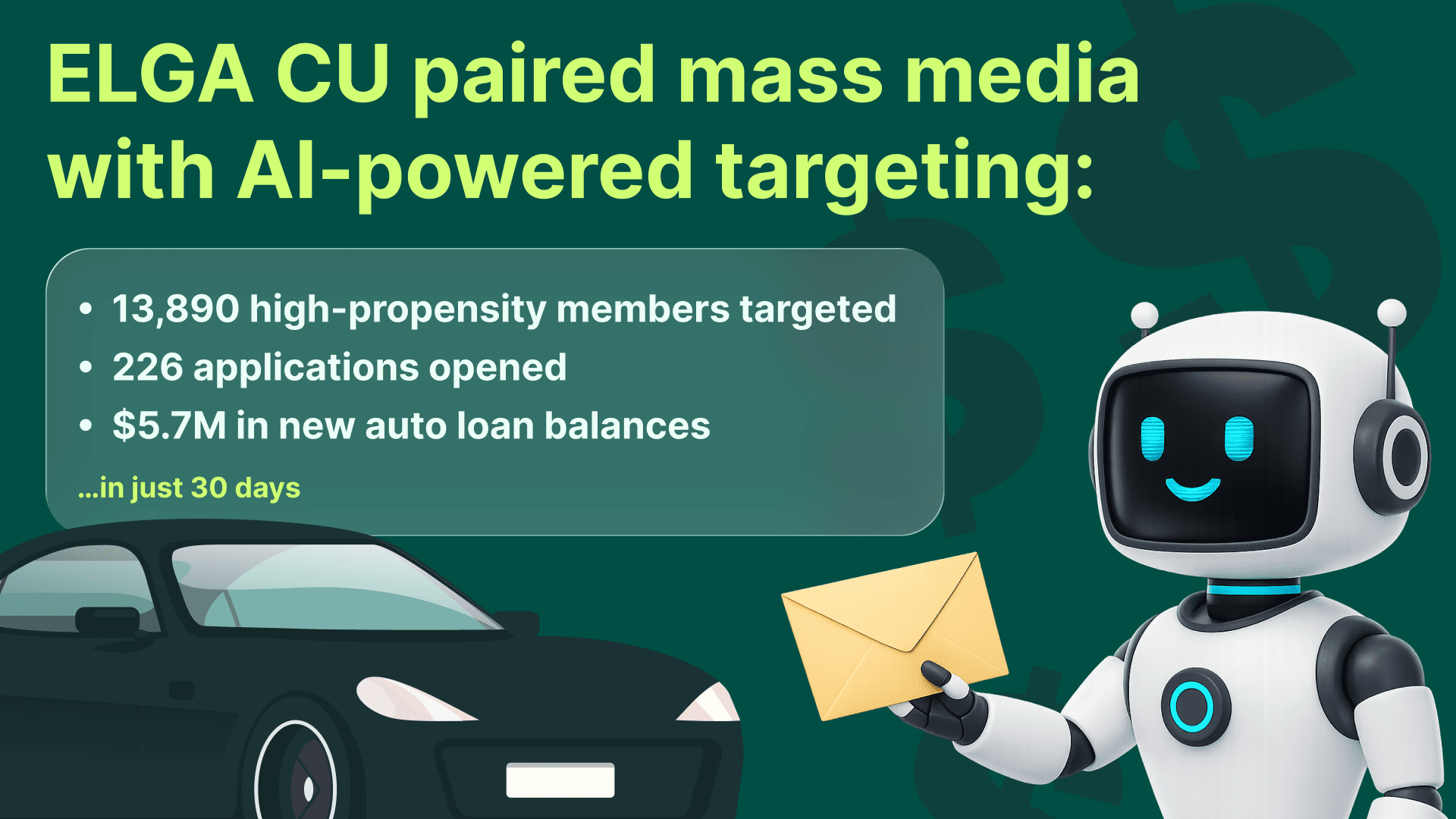
Mass media outreach, like billboards and radio ads, builds awareness, but it can’t tell you which members are actually ready to borrow.
That was the challenge ELGA Credit Union faced in Fall 2025. The Michigan-based Credit Union, which serves 100,000+ members and manages over $1.6B in assets, launched a “90 Day No Pay” direct auto-loan promotion backed by a full mass-media push including billboards, radio, Spotify ads, and in-branch signage. The awareness was there. But the team knew broad advertising alone was sending general messaging into what they called a “black hole.”
To fix that, ELGA CU layered Vertice AI’s predictive modeling on top of its existing campaign. The platform analyzed member data and identified 13,890 members with middle-to-high propensity scores, stronger engagement histories, and relevant life-stage indicators like Young Adult/Family or Retired Household. Only those members received personalized email outreach tied to the promotion. The broader community saw the billboards and radio ads, while the identified members received a message tailored to them. The team was able to build and manage the targeted campaign without needing a data team or manual extraction, identifying the audience in minutes compared to a longer traditional timeline.
The results came within 30 days. The targeted group generated 226 loan applications, $5,772,149 in total balance added, and an average auto-loan balance of $26,847 per member. That average balance was 48.5% higher than the non-targeted group. Overall, the targeted campaign outperformed non-targeted efforts by 167%. The targeted group also opened more than twice as many additional products as members exposed only to mass-media advertising. (link)
2) American Banker’s 2026 AI Talent Shift Survey reveals where Credit Unions stand
A new survey of 206 banking professionals from American Banker reveals a financial services industry that is accelerating into AI faster than most Credit Union leaders may realize. And the gap between those investing heavily and those moving cautiously is already showing up in real operational results.
Credit Unions are lagging on AI prioritization compared to the rest of the industry. Only 23% of Credit Union leaders rank AI as a top organizational priority, versus 63% of national banks and 44% of regional banks. At the same time, 44% of Credit Union respondents said AI is a moderate to low priority — the highest share of any institution type in the survey. Yet when asked why they are investing in AI at all, 73% of Credit Union executives cited productivity improvement as their top rationale, tied with automating key tasks and workflows. So the intent is there, but the urgency appears to be lagging. (link)
The data is clear on what happens when institutions do commit. Among organizations that increased AI spending by 25% or more in the last 12 months, roughly 60% reported moderate to significant productivity gains. That number drops to 40% for those who increased spending by 10% to 24%, and falls further to 16% for those who increased spending by less than 10%. Departments that expanded AI investment also expanded their capabilities. About 75% of respondents who upped AI spending by 25% or more said their department’s capabilities grew over the past year. AI integration was cited as the number one driver of improved productivity by 41% of respondents, ahead of internal efficiencies (34%), new technology (25%), and task automation (23%). (link)
The short-term job outlook looks stable, but the longer-term signals are harder to ignore. Today, only 3% of banking professionals say AI has led to workforce reductions at their institutions, with 28% reporting efficiency gains and 12% citing role augmentations. But 33% of national bank executives and 30% of regional bank executives expect significant headcount reductions at their organizations within the next 12 months. Surjit Chana, a board member of Beneficial State Bank and Harvard fellow, warned that clerical and administrative roles face the highest displacement risk, and that institutions have a responsibility to invest in reskilling before the transition happens faster than they can manage. Clearview FCU’s CIO Raymond George put it plainly to his own staff: “AI may not take your job, but somebody who knows AI will.” (link)
3) Texas Tech FCU cuts response times 50% with voice AI
Handling routine member calls one at a time is a drain on any Credit Union. Agents stuck answering balance inquiries can’t focus on the complex conversations that actually build relationships.
At Texas Tech Federal Credit Union, that problem was compounded by a legacy contact center platform that siloed voice from digital channels entirely. When a chat interaction escalated to a phone call, members had to repeat themselves. Managers had no unified view of agent performance. And with no reliable data, strategic decisions felt, in Consumer Banking Director Tyler Young’s words, “unfocused.”
Texas Tech FCU had already deployed Glia’s digital platform for chat. When it became clear the voice channel needed the same upgrade, the Credit Union turned to Glia again, this time for voice AI.
Before launching, Glia conducted an Impact Study — a deep analysis of Texas Tech FCU’s call traffic to identify which high-volume, routine inquiries could be automated. The study gave leadership hard data to bring to their board. “We now understand why members are calling into the service center, and we can make better decisions based on that data,” Young said.
The Credit Union deployed Glia Banker, naming its voice AI agent “Scarlet.” Glia’s library of 1,000+ pre-built banking-specific inquiry responses allowed the team to launch quickly without building journeys from scratch. “I honestly cannot imagine how long the writing process would have taken without these AI tools,” said Member Services Manager Jessica Pharr.
Scarlet now fully handles 25% of all incoming calls, with the containment rate expected to reach 50% once authenticated actions like account transfers go live. When calls do escalate, Glia’s AI Transfer Summary gives agents full context before they even say hello, so members never have to repeat themselves. Average speed of answer improved by 50%. Agent onboarding time dropped from six weeks to four, a 33% reduction, thanks to consolidating on a single platform. The team saves 81 hours of agent work per month, equivalent to one part-time staff member. Managers reclaimed 14 hours per month through automated quality assurance, allowing coaching to shift from monthly to weekly. Digital engagement also climbed 8.6% over the last year as members moved more seamlessly between channels. (link)

Tips & Use Cases
Learn to apply AI…
Altra FCU uses AI across its entire marketing engine: CMO Cheryl Dutton says AI-powered audience targeting through Google Performance Max and a social media analytics platform helped drive over 200,000 member engagements against an industry benchmark of 54,000, while Synthesia cuts video production time for their in-house team. Altra also runs ACE, a 24/7 virtual assistant handling roughly 1,000 member questions per month, and deployed Microsoft Copilot internally for content generation. (link)
AI cuts financial counseling prep from days to minutes: Shirley Senn, Chief Community Development & Impact Officer at New Orleans Firemen’s FCU, says AI can compress cash flow analysis and budget prep from two days down to five minutes, freeing counselors to spend that time on the member conversation that actually matters. (link)
Stanwood Area FCU CEO says AI should free staff to connect: Charles Frederickson says AI should handle account opening paperwork and applications so staff can spend more time understanding what members actually need. His Credit Union’s goal isn’t just better finances for members, it’s a better quality of life. (link)
Marine Credit Union automates mortgage document classification with Ocrolus: Business Systems Administrator Heather Olson says the platform automatically sorts and places incoming loan documents into the correct locations, eliminating inconsistent manual filing across underwriters. Early results point to faster income analysis, more consistent debt-to-income calculations, and a more streamlined borrower experience. (link)
AI is how Credit Unions win back member loyalty: Mark Sievewright, Chief Strategy Officer at Sievewright & Associates, an SRM company, says the concept of a primary financial institution is dead as members now spread relationships across seven to thirteen providers. He argues Credit Unions that become data-driven and AI-enabled can free up loan officers and member service reps to focus on the relationship work fintechs can never replicate. (link)
AI underwriting cuts loan decisions from days to 30 minutes: Lenders using AI underwriting report 80% faster decisions and 75% improvement in operational efficiency, while 43% of applicants abandon applications if they wait more than 24 hours for feedback. Credit Unions still in pilot mode risk falling behind as AI already automates up to 95% of manual underwriting decisions at institutions that have fully deployed it. (link)
TD Bank report finds 83% of workers now use AI on the job: TD Bank’s second annual AI Insights Report found workplace AI adoption jumped 20 percentage points YoY, with 71% of users saying it gives them a competitive edge over peers. Despite the surge, only 18% would trust AI to make financial recommendations entirely on its own. (link)
How Credit Unions can use AI to close language gaps: With nearly 75M Americans speaking a language other than English at home, AI translation tools can help Credit Unions serve non-English-speaking members across marketing, financial education, and contact centers without replacing bilingual staff. Starting small, like translating existing blogs or adding language options to contact center menus, lets teams build familiarity before scaling. (link)
Big banks signal AI will shrink workforces through attrition: JPMorgan Chase has deployed a large language model used by roughly 150,000 employees weekly, Block cut 40% of its workforce citing AI, and Goldman Sachs has already moved to constrain headcount growth. Credit Union leaders watching these trends should start conversations now about how AI will reshape roles before staff anxiety gets ahead of the plan. (link)
Scienaptic AI joins DCUC to expand credit access for military members: Scienaptic AI’s iCUE platform uses agentic AI to help Credit Unions assess borrowers on a fuller financial picture, addressing data gaps caused by frequent military relocations and deployments. The partnership gives Credit Unions serving DCUC’s 143M members access to faster, more transparent lending decisions built for complex lending environments. (link)
DailyPay cuts AML analyst workload 50% with agentic AI: DailyPay deployed ComplyAdvantage’s agentic AI to research flagged transactions and deliver summaries to human analysts, cutting their workload in half while keeping humans in charge of final decisions. (link)
Visa survey finds businesses embrace AI agents, but consumers want guardrails: Visa surveyed 2,000 Americans and 500 businesses and found 53% of businesses will let AI agents negotiate directly with other AI agents, but only 27% of consumers are comfortable letting AI spend money without limits. Trust jumps when financial institutions are involved, with 36% trusting bank-backed AI systems versus 28% trusting independent AI agents. (link)
Why banks should keep hiring junior tech staff despite AI: A study in Communications of the ACM found programming and database roles face up to 80% AI disruption exposure by 2032, but banks that stop hiring juniors today risk a supervision crisis by 2030 with no pipeline of staff who can audit AI outputs, catch errors, or understand why systems were built the way they were. (link)

Funding Spotlight
Where the money is flowing for innovation…
Capital One closes $5B acquisition of Brex to expand agentic AI: The deal adds Brex’s 35,000 business banking clients and a suite of agentic AI tools, including expense, review, auditing, and accounting agents that automate back-office financial workflows. Capital One plans to spend nearly $1B over three years to integrate Brex into its broader payments strategy. (link)
AccuQuant raises $20M to build AI-driven financial decision infrastructure: The fintech platform will use the funding to advance machine learning, automated execution, and risk control systems designed to support data-driven decision-making across digital financial applications. (link)
DepthFirst raises $80M Series B to secure AI software infrastructure: The applied AI security lab, which raised $40M just 90 days earlier, will use the funds to train additional security models and accelerate enterprise adoption of its platform that identifies vulnerabilities and delivers fixes directly inside developer workflows. Its first in-house model outperformed frontier models at 10 to 30 times lower cost in early testing. (link)
Variance raises $21.5M Series A to deploy AI compliance agents: Variance’s AI agents handle KYC, KYB, AML, transaction monitoring, and fraud detection by reasoning across fragmented data sources and returning fully auditable decisions in minutes instead of days. Variance processes more than 70M context signals daily and carries out around 300,000 automated enforcement actions across customer environments. (link)
Cara raises $8M seed to automate insurance brokerage workflows: The AI platform cuts processes that traditionally take 90 minutes down to roughly two minutes by automating coverage comparisons, proposal generation, ACORD form completion, and customer service requests via voice and email. (link)

Keeping up with Tech
The latest in fintech and tools…
Visa, Mastercard, and Microsoft race to deploy AI shopping agents: Visa piloted its Intelligent Commerce platform with DBS Bank and Banco Santander. Mastercard completed Europe’s first live end-to-end AI agent payment. And Microsoft launched Copilot Checkout in the US in January, letting consumers complete purchases without visiting external sites. (link)
Visa rolling out 6 AI-powered dispute resolution tools for issuers and merchants: The suite includes a GenAI representment tool with win prediction scoring for merchants and a Dispute Intelligence tool that uses predictive AI to help issuer agents make more informed case-by-case decisions. Visa processed a record 106M disputes globally in 2025, a 35% increase since 2019. (link)
Visa and Ramp deploy AI agents to automate corporate bill payments: Using Visa’s Intelligent Commerce and Trusted Agent Protocol, the partnership replaces manual payment workflows with AI automation and real-time spending controls for Ramp’s 50,000 corporate clients. The platform combines corporate cards, expense management, bill payments, procurement, travel booking, and automated bookkeeping into a single AI-managed system. (link)
FactSet launches AI workflow automation ecosystem for banking: Built with Finster AI, the platform uses trigger-based agents to automate deal processes like pitch materials, company profiles, and buyer analysis across the full investment banking lifecycle through natural language prompts. The system integrates with Microsoft Office and supports private cloud deployments designed for regulated financial environments. (link)
Google releases Gemma 4 open AI models for agentic workflows: The new model family supports function-calling, structured output, and multi-step reasoning natively, making it easier for developers to build autonomous agents without proprietary model restrictions. (link)
OpenAI cuts ChatGPT Business pricing and adds pay-as-you-go Codex seats: ChatGPT Business drops from $25 to $20 per seat annually, and teams can now add Codex-only seats with token-based billing and no rate limits, making it easier to run focused AI coding pilots without committing to full seat licenses. (link)
Anthropic secures multi-gigawatt TPU deal with Google and Broadcom: The compute expansion, expected online starting in 2027, will support Anthropic’s Claude models as run-rate revenue surpassed $30B in 2026, up from $9B at the end of 2025. The number of business customers spending over $1M annually doubled to 1,000 in less than two months. (link)
FinBox adds MCP support to Sentinel AI for agent-driven lending: The update allows AI agents and internal copilots to trigger credit decisions, fraud checks, and policy-governed approvals directly through natural language without duplicating underwriting logic or bypassing compliance controls. Loan officers can now simulate scenarios or move borrowers from inquiry to approval within a single AI interaction while all decisions remain centrally governed and auditable. (link)
Exabeam expands AI agent behavior monitoring for ChatGPT and Copilot: The updated Agent Behavior Analytics platform now tracks how employees use ChatGPT and Microsoft Copilot by baselining normal usage patterns and flagging anomalies like sudden spikes in API calls, unexpected privilege escalations, or prompt injection attempts. (link)

In Other News
Related news you can learn from…
Responsible AI is the foundation for innovation in banking (link)
Stablecoins and tokenization are reshaping banking, and waiting is the biggest risk (link)
AI agents are exposing broken governance models in enterprises (link)

Community Corner
Memes and visuals…

Thanks for reading!
Until next week,
— Credit Union AI Guy
Enjoying this newsletter? Forward it to a colleague who might appreciate practical AI insights.
Have a question or want to share your own AI experiment? Reply to this email or connect with us on LinkedIn. We’re building a community of curious Credit Union professionals. Come join the conversation!