


How are Credit Unions actually getting started with AI when there’s no playbook?
Three CU tech leaders are making moves to build policy from scratch, test tools at the executive level, and layer AI into operations one use case at a time.
This week, I cover:
How ESFCU is rolling out in-house agentic AI
St. Cloud Financial’s CUSO compresses core conversion analysis to minutes
BECU’s CISO says AI-powered attacks now hit tens of millions per day
Read time: 9 minutes

Top Stories
The biggest news this week…
1) How ESFCU is rolling out in-house agentic AI
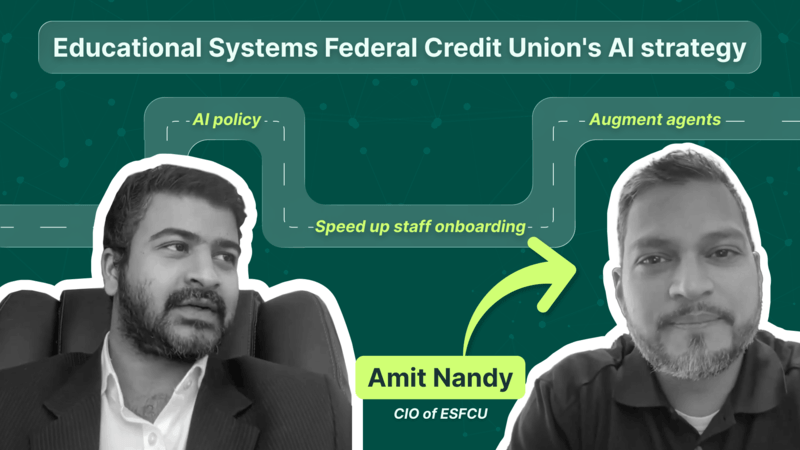
Most Credit Unions exploring AI are buying it off the shelf. Educational Systems FCU is building its own.
Amit Nandy joined ESFCU as CIO in April 2025 and found no AI policy in place. His first move was creating a foundational AI policy with guardrails for how the 200-person Credit Union would adopt the technology. He then stood up a dedicated emerging technologies team focused on the intersection of enterprise data management, software development, and artificial intelligence.
That team is now building 3 agentic AI use cases set to go live in the first half of 2026: The first is a conversational AI tool for new employee onboarding. ESFCU calls its staff “ambassadors,” and the agent will let new hires search policies, procedures, and guidebooks through a digital interface instead of combing through documents manually. The second is an AI layer that augments contact center and digital chat agents with both internal and external data sources to speed up member service. The third takes the Credit Union’s top five support request channels by volume and converts them into in-house conversational AI agents built on an agentic platform ESFCU controls.
The decision to build rather than buy was deliberate. Nandy said too many Credit Unions let third-party vendors drive their AI roadmaps, and he wants ESFCU to design and own its agents instead. (link)
2) St. Cloud Financial’s CUSO compresses core conversion analysis from 2 weeks to minutes
When two Credit Unions merge or switch cores, finding what broke used to take about two and a half weeks of manual review. AI now does it in minutes.
St. Cloud Financial Credit Union is a five-branch, $425M institution serving 28,000 members in central Minnesota. CEO Jed Meyer has driven 400% organic growth over nearly 12 years, with 2025 marking the best year in the Credit Union’s 96-year history. The Credit Union also operates DaLand CUSO, which has handled core conversions since 2009. That team now uses AI to run virtual mergers and virtual core conversions, surfacing the full subset of errors in minutes instead of relying on a report that flags a problem and sends staff on a two-and-a-half-week manual hunt.
Meyer is approaching AI adoption deliberately across the Credit Union itself. His CTO is currently enrolled in a 12-week AI course at MIT. Meyer and two other executives are each testing different AI tools internally, including one that builds a personal identity profile Meyer can plug into any AI system so it learns his context before he prompts it. He also uses an AI coworker tool for conference prep that pulls from his previous presentations to suggest what he should say again.
But Meyer draws a firm line on where AI belongs. He sees it as a coworker extension, not a replacement, especially in member-facing roles. His philosophy: let technology handle accuracy and speed so humans can focus on building relationships. The Credit Union kept all staff in-person through COVID, never adopted work from home, and plans to recruit talent from competitors that replace employees with AI. (link)
3) BECU’s CISO says AI-powered attacks now hit tens of millions per day
The fourth-largest Credit Union in the country is rebuilding its cyber defenses around AI because traditional tools can no longer keep up.
Sean Murphy is Sr. VP and CISO at BECU, a $30B community-based Credit Union in Washington state. He leads a 60-person security team spanning risk management, identity and access management, security operations, platform engineering, and disaster recovery. Murphy says the volume and sophistication of attacks against BECU has changed dramatically. What used to be tens of thousands of attacks per day is now tens of millions in minutes or hours.
Murphy’s team is taking a layered approach that adds AI on top of traditional defenses. Data loss prevention, URL filtering, and CASB/SASE tools handle the first lines of defense. AI then layers in to analyze email content and meaning, creating three to four chances to catch a threat before it reaches a user. Matthew Connor, host of the Cyber Business Podcast, points to tools like Darktrace and Abnormal as examples of AI-powered email security done right, where machine learning flags new URLs that are only hours old and removes suspicious messages before staff ever see them.
Beyond email, Murphy identified three other areas where BECU is focused on bringing AI capabilities in. Identity and access management is a top priority. Vulnerability management and risk prioritization is another, where AI helps the team triage exposure faster than manual review allows. The third is agentic SOC analyst workflows that automate parts of the security operations center. (link)

Tips & Use Cases
Learn to apply AI…
Building a bank from scratch reveals what’s holding yours back: Cornerstone Advisors says they’d start with a clean data model, embed AI agents from day one, and hire a small team fluent in both tech and credit. The gap they’re trying to close: average banks generate $250-300K in revenue per employee, while Chime runs at $1.5M per. (link)
3 steps to build a marketing simulator without coding: Define your goal in a simple brief, paste it into a vibe coding tool like Lovable.dev, and use plain-English prompts to turn any Excel spreadsheet into a shareable web app in under two hours for less than $25. (link)
What Credit Union leaders didn’t expect after launching AI: A survey of bank and Credit Union executives found that customer adoption came faster and with less friction than anyone predicted, staff began treating named AI tools like colleagues rather than software, and containment rates kept improving for months after launch. The most universal surprise: going live exposed years of outdated, inconsistent internal knowledge that nobody knew was broken until the AI made it visible. (link)
The real barriers to AI adoption aren’t what you think: A survey of 80 bank and Credit Union leaders found that 81% expect AI’s biggest near-term impact to be internal employee efficiency, not member experience. The top barrier to adoption was proving ROI to boards at 42%, followed by internal cultural resistance at 27%, while technical and data hurdles ranked last at just 12%. (link)
Allica Bank auto-decisions SME loans in 12 minutes with AI: The British challenger bank is live-testing an agentic AI system that reads unstructured email loan applications and returns a credit decision with no human involvement, hitting a 50% auto-decision rate in early testing and cutting turnaround from days to 12 minutes. Internal AI adoption has climbed from 25% of workdays a year ago to 70% today, with product and engineering teams at 92%. (link)
AI agent writes 75% of CommBank’s card fraud rules: The system monitors more than 80M daily signals across transactions, card payments, and digital channels, automatically identifies emerging threat patterns, and proposes new detection rules to intercept them without waiting for human analysts to catch up. (link)
Fraud systems are blocking legitimate AI shopping agents: As AI agents increasingly complete purchases on behalf of consumers, fraud detection tools built for human behavior are misclassifying them as malicious bots, triggering false declines and lost revenue before a chargeback ever gets filed. Chargebacks911 warns that 51% of internet traffic is now bot-generated, making legitimate agents nearly indistinguishable from threats. (link)
Banks have a narrow window to shape AI agent identity standards: AI agents have no device fingerprint, no behavioral biometrics, and traffic patterns indistinguishable from bot attacks. Morgan Stanley estimates nearly half of online shoppers will delegate purchases to AI agents by 2030, and banks that don’t help build the identity verification framework now risk watching that volume flow to alternative payment methods that will. (link)
Citi launches Arc to deploy AI agents across 180,000 employees: The platform lets developers build agents for specific business use cases, with plans to expand access over time so staff encounter agents embedded directly in their daily workflows. Citi says a wealth banker who today spends hours manually pulling portfolio data and modeling scenarios before a client meeting will instead receive that work proactively from a team of agents. (link)
Lloyds launches Envoy, an internal marketplace for AI agents: Built on Google Cloud, the platform lets teams build, share, and reuse agents across the organization through an internal marketplace, with built-in compliance checks and human oversight required throughout each deployment. (link)
CaixaBank makes AI agent the first contact for all digital customers: Built on Salesforce’s Agentforce, the agent guides customers through applications for 40 products and hands off to a human only at the final contract step. It will handle around 6,000 conversations per month once fully deployed. (link)
Amex uses GenAI to cut consultant handling time by two minutes: American Express rolled out its Travel Counselor Assist tool across 19 countries. GenAI handles research, documentation, and message filtering so human consultants can focus on complex bookings and emergencies mid-trip. (link)
Rocket Close cuts mortgage doc processing from 10 hours to two minutes: The company handles about 2,000 abstract packages per day, each averaging 75 pages. Its new AWS-powered AI system classifies and extracts data at roughly 90% accuracy, with humans still reviewing every transaction. Separately, Palantir and Moder are piloting an agentic AI mortgage platform with Freedom Mortgage to automate lending rules and speed up loan processing. (link)
Amex will cover purchases made by AI agents: The new Agent Purchase Protection covers eligible charges from errors made by registered AI agents, as long as the customer authorized the purchase and the agent submits authenticated intent. Amex is also releasing a developer kit to let AI platforms integrate its cards and membership benefits into agentic commerce workflows. (link)
Citi raises global AI market forecast to $4.2T by 2030: Nearly half of that total is expected to come from enterprise AI, up from a prior estimate of $1.2T to $1.9T. The report highlighted Anthropic as a key enterprise player, noting its annualized revenue run rate surpassed $30Bas of April. (link)
BMO boosted client card spend 45% using AI-powered payment insights: The bank uses Codat’s machine learning to pull accounts payable data from 20+ ERP systems and flag where clients still pay by check. Salespeople then use those insights to recommend card or ACH alternatives that improve working capital and reduce fraud exposure. (link)
40% of BNY’s code is now written by AI: The $562B-asset bank has 140 “digital employees” working alongside staff on tasks like payment validations, with 220 more AI solutions in development. Client onboarding completion rose 20% YoY and software releases climbed 10%. About half of BNY’s 47,000 employees use AI daily. (link)
Private credit giants stress-test portfolios for AI disruption: Blackstone found less than 5% of its flagship fund faces AI headwinds. Ares said 85% of its software-oriented investments carry low risk, with about $1B at “medium” risk and just 1% rated high. All three firms noted that some software borrowers stand to benefit from AI rather than be displaced by it. (link)

Funding Spotlight
Where the money is flowing for innovation…
Visa + Mastercard back Astrada’s $3.8M seed round: Astrada provides a real-time data layer for business spend through a single API, processing over $750 million in card transactions since 2024. The funding will accelerate its push to support both human and AI agent-driven financial workflows. (link)
Rogo raises $160M Series D to scale AI agent for investment banking: The round, led by Kleiner Perkins, comes just four months after a $75M Series C, bringing total funding to roughly $300 million. Rogo’s new agent, Felix, automates multi-step tasks like deal screening, financial modeling, and data room diligence for 250+ institutional clients, including Rothschild, Jefferies, and Lazard. (link)
Anthropic + Blackstone + Goldman Sachs form $1.5B AI joint venture: The new entity will embed engineers inside portfolio companies to build custom AI agents and redesign workflows, starting with PE-owned firms across healthcare, manufacturing, financial services, retail, and real estate. The target: mid-market companies that want frontier AI but lack the in-house resources to deploy it. (link)
Counterpart raises $50M Series C to insure AI-era business risks: The InsurTech has written over 35,000 policies across 2,800 brokers, resolves claims more than twice as fast as industry benchmarks, and reported 175% premium growth in 2025. The funding will go toward new specialty products covering emerging liabilities like AI-related lawsuits targeting hiring, content creation, and customer service. (link)

Keeping up with Tech
The latest in fintech and tools…
Anthropic launches 10 AI agent templates for financial services: The agents handle pitchbook building, KYC screening, month-end close, and more, running as plugins inside Excel, PowerPoint, Word, and Outlook. Claude carries context across all four apps, so a model built in Excel flows into a deck without re-explaining anything. (link)
FIS + Anthropic build AI agent to cut AML investigations from hours to minutes: The agent automatically assembles evidence across a bank’s core systems, evaluates activity against known typologies, and surfaces the highest-risk cases for review. BMO and Amalgamated Bank will be among the first to deploy it. FIS sits inside 12% of the world’s banks, giving the partnership wide reach for broader rollout in H2 2026. (link)
OpenAI releases GPT-5.5 Instant with 52% fewer hallucinations: The new default ChatGPT model cuts inaccurate claims by 37% on flagged conversations and delivers tighter, less verbose responses. It also pulls context from past chats, files, and connected Gmail to personalize answers without users having to repeat themselves. (link)
OpenAI launches self-serve ad platform inside ChatGPT: The new Ads Manager lets businesses of all sizes create, manage, and measure campaigns directly within ChatGPT. OpenAI also added cost-per-click bidding alongside the existing CPM option, plus conversion tracking via API and pixel-based measurement. (link)
OpenAI adds Advanced Account Security to ChatGPT and Codex: The opt-in setting disables password-based login, requires passkeys or physical security keys, shortens session windows, and automatically excludes conversations from model training. OpenAI also partnered with Yubico to offer discounted security key bundles to all users. (link)
TRG Screen launches AI to parse market data vendor contracts in minutes: A single vendor contract can take a market data team four to six hours to analyze manually. Contracts AI extracts usage rights, restrictions, and obligations from complex legal language and turns them into searchable, auditable data that supports compliance, reporting, and renewal workflows. (link)

In Other News
Related news you can learn from…
Credit Unions weigh online vs. offline AI to balance speed with compliance (link)
Fed Vice Chair says AI supervisory report on sound practices is coming in Q3 (link)
NCUA launches resource hub to help Credit Unions manage AI adoption risks (link)
Agentic coding creates 10-20x gap between teams that adopt it and those that don’t (link)
Microsoft finds 58% of AI users now produce work they couldn’t have done a year ago (link)
White House pushes to limit access to Anthropic’s Claude Mythos over cybersecurity risks (link)

Community Corner
Memes and visuals…

Thanks for reading!
Until next week,
— Credit Union AI Guy
Enjoying this newsletter? Forward it to a colleague who might appreciate practical AI insights.
Have a question or want to share your own AI experiment? Reply to this email or connect with us on LinkedIn. We’re building a community of curious Credit Union professionals. Come join the conversation!