


How long does it take your newest hire to get on a live member call?
At most Credit Unions, the answer is still weeks.
That’s weeks of your experienced staff carrying the extra weight while new reps sit in training.
This week, I cover:
How Financial Partners CU ramps new hires in days
How GoWest is turning the tides of AI search with Credit Union PR
Members 1st built AI governance before deploying a single bot
Read time: 7 minutes

Top Stories
The biggest news this week…
1) How Financial Partners CU ramps new hires in days
Manual role-playing ate hours and couldn’t keep training consistent or trackable across the team.
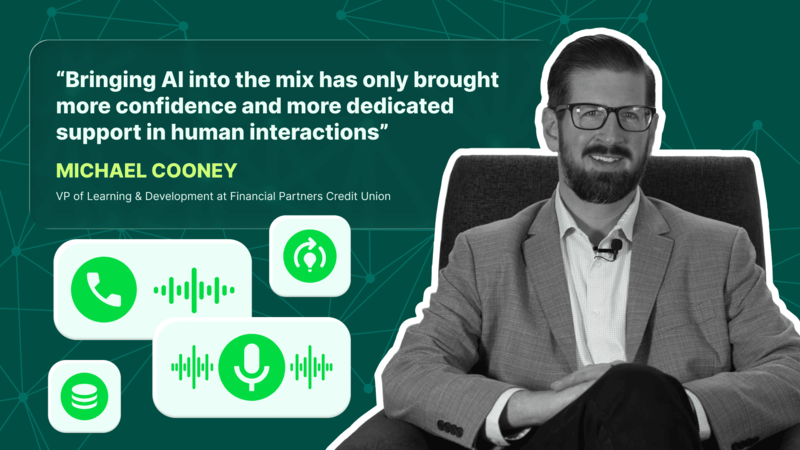
Without a dedicated role-play position, trainers doubled as practice partners. Michael Cooney, who leads L&D at Financial Partners Credit Union, says human trainers tend to “throw the easy ball.” New hires waited weeks or months before taking live member calls. The Credit Union needed practice that was realistic, repeatable, and measurable.
Financial Partners deployed Posh Simulator alongside Posh Knowledge Assistant. The team built a repeatable model: identify a real business problem, then design AI-driven practice scenarios around it. Their first target was SMS enrollment. Reps completed a 15-minute e-learning module, then ran 30 minutes of simulated member conversations. SMS enrollment jumped 5x in the two weeks after training. In one new hire class, the newest rep hit 90% accuracy by the third attempt in under an hour. Employees who once waited weeks to take calls now start within days. On live calls, Knowledge Assistant surfaces the right policy or procedure in real time, so reps aren’t relying on memory alone.
The Credit Union is now expanding Simulator to branches and outbound cross-sell campaigns. Cooney sees learning, knowledge, and live support as one connected system. “You have to have all three if you want to be effective,” he says. (link)
2) How GoWest is turning the tides of AI search with Credit Union PR
Have a marketer at your Credit Union but no PR strategy? That gap now costs the most valuable visibility in a new era of AI-driven search.
AI systems constantly scan press releases, news coverage, and award mentions to decide which organizations are credible. So when a Credit Union stays quiet, banks fill the narrative. Katy Wagnon, Chief Experience Officer at GoWest Credit Union Association, says reporters often arrive with only the banking industry’s perspective. Without earned media, Credit Unions risk becoming invisible to the AI tools consumers and journalists now rely on for recommendations.
GoWest launched a working group where Credit Unions learn to build PR skills like media engagement and storytelling. In year two, the number of participating Credit Unions nearly doubled. Wagnon says awards are one of the most underrated drivers of AI visibility. They provide third-party validation, structured data, and placement on high-authority domains. That combination is exactly what AI systems crawl for trust signals.
GoWest’s MAXX Awards saw record submissions this year across nine categories. One new category, Storytelling With Purpose, recognizes Credit Unions leading in media engagement.
Wagnon’s advice: say yes to interviews, say yes to awards, and start collecting member stories from call centers and loan officers. The work Credit Unions do every day is extraordinary. The problem is that no one outside the movement hears about it. (link)
3) Members 1st built AI governance before deploying a single bot
While many Credit Unions are rushing to add AI tools, Members 1st Federal Credit Union spent a year building the rules first.
CEO Mike Wilson says institutions that skip governance risk building workflows they depend on, only to have regulators shut them down. “If people get too cute with the way they’re using the technology… they may build out workflow processes that they become reliant on, and then a regulation comes out that says you can’t do that anymore,” he said. The $8.6B Credit Union in Enola, Pennsylvania, created what it calls an AI center of excellence. The center ties into strategic planning, project management, and vendor oversight. Members 1st also appointed an AI officer, a role the board formally renews each year alongside AML and infosec positions.
With governance in place, the Credit Union moved into deployment. It automated balance inquiries in the call center, freeing agents for fraud, lending, and financial guidance conversations. Members 1st originates $125M to $150M in auto loans per month. The Credit Union is now exploring automation for straightforward applications so underwriters can focus on borrowers who need human judgment. Wilson told staff the goal plainly: “We want you guys to change a life, not check a box.” On the fraud side, AI identifies account takeover patterns and scans the internet for stolen card data. Wilson says the Credit Union has substantially cut fraud losses.
Members 1st also tested AI at a board retreat this spring. Directors worked with six AI avatars that simulated cyber events, market disruptions, and operational crises. The session ended with an AI-generated version of Wilson delivering the findings back to the board. Each executive is now receiving a customized AI avatar to interact with daily. (link)

Tips & Use Cases
Learn to apply AI…
Unitus Credit Union cuts small business underwriting from hours to 30 minutes: AI tools moved the Credit Union from underwriting a few small business loans per year to hundreds, each taking 30 minutes instead of the same hours as a commercial real estate file. Unitus is now launching an AI Center of Excellence to set standards and train staff at every level. (link)
2 questions to ask before signing any AI vendor deal: Attorney Michael Heller says Credit Unions should prioritize: 1) a clear exit path with minimal financial loss and 2) mutually agreed milestones that define who’s responsible for what. Ambiguity in those areas is where he sees most deals fall apart within a year or two. (link)
Nvidia pitches one AI model for fraud, credit, and risk: The blueprint would train a single model on an FI’s transaction history for fraud, underwriting, risk, and compliance. Revolut trained its model on 40B transactions, and Stripe’s detection for one fraud type jumped from 59% to 97%. (link)
KPMG pulls AI report after hallucinated claims about UBS: The firm’s October report on agentic AI falsely stated UBS uses AI agents across advisory, risk, and compliance on a platform co-developed with Microsoft. UBS called the claims factually incorrect. Research group GPTZero flagged the errors as likely AI hallucinations. (link)
FSB outlines 12 practices for responsible AI: The Financial Stability Board proposed sound practices covering enterprise AI governance, cyber risk, and third-party vendor risk. Comments are due July 22, 2026, with a final report expected in October. (link)
55% of consumers would share more data for a better experience: MX research found that willingness to share financial data rose from 46% to 55% in one year. Credit Unions that build contextual consent into AI tools can let members authorize specific analyses rather than granting broad data access, keeping the institution at the center of the relationship. (link)
Banking AI returns up to 20% of the workday to agents: Glia’s 2026 Banking AI Benchmarks Report found top Credit Unions contain 91 to 95% of routine inquiries while keeping sensitive moments at 41 to 45% containment by design. Member escalation to a human stays below 10% even for fraud and lost cards, freeing reps to focus on high-value conversations. (link)
Fraud losses climb when detection stays separate: Celent found 82% of lenders reported rising fraud losses and 93% said fraud directly contributes to credit losses. Fewer than one-third use AI models, alternative data, or consortium intelligence to catch synthetic identities and loan stacking. (link)
AI usage costs spike without token budgets: Every prompt, response, and agentic workflow consumes tokens that can quickly increase costs for Credit Unions. Teams need spending alerts, model access controls, and vendor reporting before rolling out AI broadly. (link)
Federal examiners now ask about AI at virtually every bank exam: The Fed and OCC are using routine examinations to probe how institutions deploy AI in lending, KYC, and compliance. Examiners want documentation of where AI is used, what governance controls exist, and whether kill switches and vendor exit strategies are in place. (link)
Ron Shevlin calls AI clones a gimmick: Shevlin argued AI executive clones create the illusion of accessibility but cannot replace judgment, accountability, or context from real leaders. Credit Unions should focus on tools that improve decisions and member-facing value instead. (link)
Only 13% of institutions hit top digital maturity, and size isn’t the reason: Alkami research found the most mature banks and Credit Unions grow revenue at 5x their peers’ rate. One-third of that top tier holds less than $500 million in assets. The fastest-widening gap is in data activation, where generative AI lets leaders deliver targeted offers in real time while others still fight data silos. (link)
Fifth Third adds AI navigation to its mobile app for 2.4M users: The bank built 150 pre-populated options into an open-source transformer model trained on hundreds of millions of interactions. Instead of jumping to agentic AI, Fifth Third found customers value predictability and familiar screens over simulated conversations. The model learns from every tap and typed query to improve accuracy over time. (link)
BMO ties every AI project to at least one basis point of improvement: Chief AI Officer Kristin Milchanowski says BMO won’t start an AI initiative without a measurable return in revenue or cost reduction. The bank plans to grow revenue while keeping headcount stable, using AI to boost capacity rather than cut staff. (link)
Bank of America plans 1,000 in-person fraud classes this year: The bank’s “scaminars” teach customers how to spot AI-powered scams like deepfakes and synthetic identities. Americans lost $15.9B to fraud in 2025, up from $12.5B in 2024, with AI driving much of the increase. (link)
PNC builds its own AI factory to avoid vendor lock-in: The $603B bank is buying Nvidia chips, acquiring data centers, and building internal language models for tasks like fraud detection and call centers. CEO Bill Demchak says relying on external tokens risks letting AI vendors claw back any productivity gains through pricing. (link)

Funding Spotlight
Where the money is flowing for innovation…
Flagright raises $12.5M to expand AI compliance for banks and Credit Unions: The platform centralizes transaction monitoring, screening, and investigations in one audit-ready system, serving 100 fintechs and banks across 30+ countries. Funding will go toward explainable AI for compliance and U.S. market expansion. (link)
Waniwani raises $8M seed to connect vendors with FIs through AI apps: The startup’s open-source SDK lets financial service vendors deploy sales agents inside ChatGPT, Claude, and Copilot, while giving institutions compliance and brand controls over the experience. (link)
NewCore raises $66M seed for AI identity security: NewCore emerged from stealth to secure human, machine, and AI-agent identities across enterprises. The platform treats AI agents as first-class identities with lifecycle controls, trust scoring, and revocation paths. (link)
Compuvi closes $40M seed round for preventive AI compliance: The company plans to grow Confinaid, its AI-powered platform for preventive compliance risk intelligence across legal and regulatory domains. Funding supports AI engineering, U.S. and EU expansion, and SOC 2 Type 2 and ISO certifications. (link)
Cyera raises $600M for AI data security: The $12B valuation brings total funding above $2B for a platform covering data security posture management, DLP, privacy, and agentic AI security. Cyera says 68% of organizations cannot distinguish between human and AI agent activity. (link)

Keeping up with Tech
The latest in fintech and tools…
Anthropic pulls new AI models after export order: The Commerce Department ordered Anthropic to block foreign nationals from accessing Fable 5 and Mythos 5, prompting a full public access shutdown. Credit Unions need contingency plans if key AI models are suddenly restricted by national-security rules. (link)
FIS + Anthropic launch AI agent for anti-money-laundering investigations: The tool compresses hours of manual AML work into minutes by gathering evidence across bank systems and prioritizing high-risk cases for human review. BMO and Amalgamated Bank are first to deploy, with broader availability planned for late 2026. (link)
OpenAI acquires Ona for secure coding agents: The deal brings secure cloud execution into Codex, which now has 5M+ weekly users and is up 400% this year. Ona gives agents persistent workspaces with controls for credentials, logs, and customer cloud boundaries. (link)
OpenAI Academy adds three free courses on AI workflows and agents: The courses cover AI fundamentals, building repeatable workflows, and directing agent-assisted work. BBVA is among the early partners, and completions come with shareable certificates. (link)
OpenAI commits $150M to AI partner network: The program helps firms build, sell, and deploy AI solutions across strategy, governance, and workflow redesign. Launch partners include Accenture, Bain, BCG, and McKinsey, with plans to train 300,000 consultants by end of 2026. (link)

In Other News
Related news you can learn from…
Financial institutions adopt AI at 2x the rate of regulators (link)
Workers feel AI displacement but receive little employer training (link)
Claude Fable 5 shutdown exposes AI model access as a CFO-level risk (link)
Credit Unions urge Senate to keep AI rules proportional for smaller institutions (link)
Finance students face AI-powered interviews for jobs AI may eventually replace (link)

Community Corner
Memes and visuals…

Thanks for reading!
Until next week,
— Credit Union AI Guy
Enjoying this newsletter? Forward it to a colleague who might appreciate practical AI insights.
Have a question or want to share your own AI experiment? Reply to this email or connect with us on LinkedIn. We’re building a community of curious Credit Union professionals. Come join the conversation!