


The Credit Unions pulling ahead with AI are bringing structure to fragmented workflows, scattered knowledge, and inconsistent member service.
Let’s get into how they’re pulling it off.
This week, I cover:
How Heartland CU made 5 specialists available across 13 branches at once
Together CU’s AI handles 66% of calls while maintaining 94% member satisfaction
Clearview FCU embeds AI into everyday workflows, one team at a time
Read time: 9 minutes

Top Stories
The biggest news this week…
1) How Heartland CU made 5 specialists available across 13 branches at once
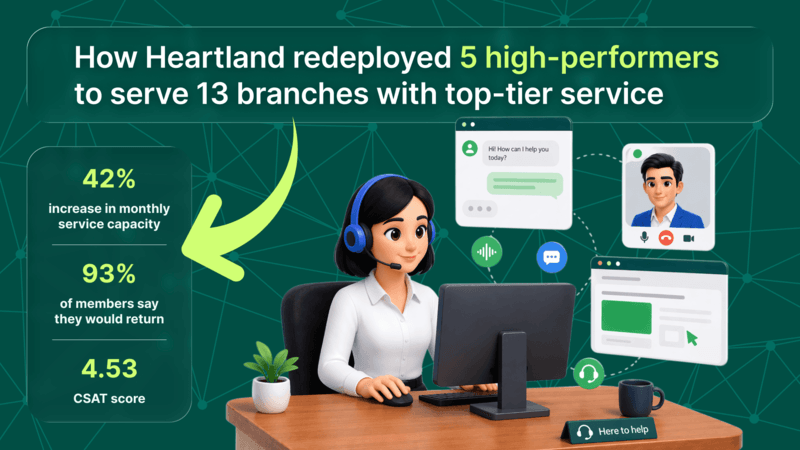
After 80 years of serving Wisconsin, Heartland Credit Union was about to go through a significant merger that’d rapidly expand its membership, and its aging phone-only contact center wasn’t going to make it. Agents spent precious time manually identifying and routing callers, driving up handle times and testing member patience. Members flooded phone lines because there were no digital alternatives, pushing abandonment rates higher. And leaders were making staffing decisions on instinct because real-time data didn’t exist. Something had to change.
So Heartland partnered with Glia and started with a single chat queue before expanding to Glia’s full Banking AI Platform, which unified voice and digital channels into one system. Daniel Mijal, VP of Digital Strategy, said the integration with Heartland’s existing Alkami digital banking platform was the deciding factor. The unified platform also gave leaders access to real-time performance metrics for the first time. Using that data, Heartland discovered most “abandoned” calls were actually members hanging up and quickly redialing for faster service, and deployed Glia’s Callback feature to address it. Abandonment eventually dropped 62%, down to 10%.
Next, the Credit Union created a centralized Digital Branch Team, pulling five specialists out of branches into one digital hub. Those specialists now serve members via video chat, on-screen voice, and CoBrowsing, where agents can take over a member’s screen in real time to guide them through tasks like uploading documents during a loan application. Members can also show ID over video to complete authentication instead of answering a series of security questions.
The end result? Handle time dropped 40%, down to just 181 seconds. Monthly service capacity grew 42%, from 4,500 to 6,400 interactions, without adding headcount. Service levels hit 97%. Mijal said centralizing training also made it easier to keep staff confident and compliant, because four specialists could handle complex areas like compliance deeply, rather than trying to get 60 people fully proficient on everything. (link)
2) Together CU’s AI handles 66% of calls while maintaining 94% member satisfaction
If a member walked into a branch, got an answer, then called the contact center and heard something different, Together Credit Union knew the real problem wasn’t training. It was the absence of a single knowledge base that every channel or employee could draw from.
Tom Kraus, Chief Experience Officer, said the inconsistency was one of the most frustrating experiences a member could have. After a broad vendor search, Kraus said he wanted a partner beyond just the contact center, not a point solution, and Posh stood out.
Together CU deployed Posh AI across three channels. Their Posh-powered voice agent, named Heather, now contains 66% of total inbound calls without reaching a live agent, a 12-point lift from where they started. Before their Knowledge Assistant, named Kai, went anywhere near live interactions, Together CU deliberately phased the rollout and made sure internal buy-in from staff came first. Kraus was direct about why: better-informed employees produce better member experiences, and the two are inseparable. Kai now gives agents a single, always-accurate resource to pull from in real time, and when information updates, it propagates instantly across every channel. Meanwhile, a Digital Assistant extended service capacity after hours, allowing members to self-serve routine transactions without creating a backlog for the morning team.
Member satisfaction held above 94% throughout the rollout, average wait times dropped 10%, and after-hours escalations to their third-party contact center fell 14%. Together CU is now planning to automate CD renewals and indirect member onboarding through Posh Outreach next. (link)
3) Clearview FCU embeds AI into everyday workflows, one team at a time
When employees at Clearview Federal Credit Union started experimenting with ChatGPT and Microsoft Copilot on their own, leadership moved to put structure around the use. The goal wasn’t a single “big-bang” automation project. It was making teams more efficient, better informed, and faster to act across the organization, without rushing the rollout.
Raymond George, CIO at the $2.1B Pittsburgh-based Credit Union, started by establishing controls around Copilot and adding ChatGPT site licenses. The Credit Union then ran prompt training for managers and selected staff before expanding adoption through town halls and shared internal examples. From there, use cases spread in what George called a distinctly Credit Union way: less flashy, more operational. Member experience teams use AI to analyze inbound issues and identify emerging themes. HR uses it for job descriptions. Staff use it to speed up presentations, emails, and document creation. During audits and policy reviews, AI now helps update language and organize material that used to take significantly longer.
On the fraud side, Clearview is using AI-driven routines to analyze events like password changes, email updates, and phone number changes that can signal account takeover or scam patterns. A phone number change followed by a Zelle transaction, for example, is one pattern Clearview has tied into robotic process automation to flag or shut down accounts for review. The Credit Union is also exploring AI to compare remote deposit capture images against metadata to catch check fraud anomalies. In lending, Clearview implemented Zest AI for automated underwriting, which evaluates more data than a human underwriter can realistically process and approves loans more quickly. George also uses Zest AI’s LuLu tool for peer comparisons, 5300-style analysis, and portfolio trend work.
As internal use cases keep multiplying, Clearview started organizing and centralizing prompts, workflows, and emerging agents so departments aren’t reinventing the same tools separately. The next phase combines Azure, robotic process automation, and quality assurance into an interactive internal assistant built off the Credit Union’s own knowledge base. (link)

Tips & Use Cases
Learn to apply AI…
Farmers Insurance FCU is using AI to scale without adding headcount: Mirella Reznic, president and CEO of Farmers Insurance FCU, says the Credit Union is applying AI to commercial lending document analysis, vendor sentiment analysis, and call center coaching to contain costs as it grows. She says institutions should think less about adding staff and more about using AI to improve productivity. (link)
AI gives small Credit Unions a real edge, with the right guardrails: Gene Pelham, former CEO of Rogue Credit Union, says AI can help smaller Credit Unions compete at a higher level by creating efficiency, but only if boards first establish clear governance over what AI will and won’t do, with humans making all final decisions. Troy Stang, CEO of GoWest Credit Union Association, adds that smaller Credit Unions are often the most nimble and can use these tools to reach member needs faster than larger institutions. (link)
Wealthfront bets AI can automate the $13T mortgage market: CEO David Fortunato says AI and pandemic-era digitization have made mortgage automation finally viable. Wealthfront is already delivering rates more than 50 basis points below the national average by cutting the $10,000 per-loan cost that traditional originators carry. (link)
AI agents could make banking a daily habit: Alex Johnson of Fintech Takes says personal finance AI agents are coming that members can chat with interactively, which is a fundamentally different experience than anything banking has offered before. (link)
3 questions every Credit Union should ask before deploying AI in lending: How can it improve decisioning? How can it drive efficiency without losing the human touch? How can it better serve members? Credit Unions that answer all three are seeing cycle times drop by 35% and automation increase by 50%. (link)
OpenAI’s second fintech acquisition threatens banks’ financial advisor role: OpenAI acquired personal finance startup Hiro Finance to build financial advisory capabilities directly into ChatGPT. If consumers start going to ChatGPT for financial guidance instead of their bank, institutions risk becoming background infrastructure rather than trusted advisors. (link)
Big banks are investing in AI startups at a 21% annual growth rate: Wells Fargo, Citi, and Goldman Sachs lead all U.S. banks in AI venture deals since 2019, with 81, 77, and 70 deals, respectively. Venture investor Ryan Falvey warns that banks not aggressively adopting AI are being passed by competitors at a pace most don’t yet realize. (link)
AI in banking is only as good as the humans guiding it: Former OCC Comptroller Eugene Ludwig urges every institution to designate a person or task force to evaluate AI systematically, while keeping experienced domain experts in the loop on every consequential decision. (link)
5 skills CFOs use to actually get value from AI in finance: HPE cut reporting cycles 40%, DBS Bank generated $1B in AI value, and Dell built proprietary agents inside finance. Results came from mastering: 1) letting software handle the math while AI handles the narrative, 2) making the CFO personally accountable for AI outcomes, 3) redesigning workflows before adding any tools, 4) giving AI persistent context about the business, and 5) locking in compliance and auditability before deployment. (link)
Citizens Bank is using AI to help branch staff show up better prepared: Karen Swiatocha, head of branch distribution transformation at Citizens Bank, says AI will soon brief branch bankers before every customer appointment, surfacing relationship history, recent complaints, and sentiment so staff can meet members where they are rather than starting from scratch. (link)
Regulators now expect Credit Unions to explain every AI lending decision: The CFPB made clear in its Winter 2025 Supervisory Highlights that there’s no advanced technology exception to federal consumer financial laws. Any AI model used in credit decisioning must produce specific, individualized reasons for adverse actions in denials, maintain full audit trails, and be tested for disparate impact across protected groups. (link)
Jamie Dimon says AI will reshape every function in banking: JPMorgan’s 2026 shareholder letter states AI will affect virtually every function, application, and process at the bank. Ron Shevlin of Cornerstone Advisors says this mirrors what survey data shows, but warns most Credit Unions are still only deploying AI in a handful of departments. (link)
New report finds AI adoption separates Credit Union leaders from laggards: A PYMNTS and Velera survey of 500 Credit Union executives found that top performers are not the biggest institutions but the fastest movers on AI, mobile banking, and member-facing technology. Credit Unions that aligned their digital investments with member needs reported higher membership growth and greater assets per member. (link)
Piraeus Bank launches AI hub with Accenture and Anthropic to overhaul core operations: The Greek bank is building a centralized AI engine to redesign processes across compliance, operations, customer experience, and risk management using Anthropic’s Claude. The goal is moving from individual AI deployments to a unified, enterprise-level capability built on governance and human control. (link)

Funding Spotlight
Where the money is flowing for innovation…
Spektr raises $20M Series A to automate AI compliance agents for banks and fintechs: The Danish regtech’s platform deploys nine AI agents that handle KYC and KYB tasks such as risk assessments, company research, and business verification, completing what analysts traditionally take hours to do in minutes. (link)
Slash raises $100M Series C at $1.4B valuation to launch agentic AI for business banking: The San Francisco fintech debuted Twin, an AI agent that acts as a chief of staff by accessing a company’s full financial account to surface insights and take direct action on payments and operational tasks. Slash surpassed $250M in annualized revenue in 2025, up 2,400% in two years. (link)
Artemis emerges from stealth with $70M of funding to fight AI-driven cyberattacks in financial services: The AI-native security platform correlates signals across cloud, identity, and network environments to surface attack narratives instead of individual alerts, cutting investigation times by 96% for one enterprise client. (link)
Wealth.com raises $65M Series B to scale AI estate and tax planning for advisors: The platform’s proprietary AI engine, Ester, processed over 100,000 estate documents in 2025 and now serves advisory firms managing more than $15T in client assets. (link)
American Express acquires Hypercard to expand agentic commerce capabilities: Amex agreed to buy Hypercard, an AI startup that automates corporate expense categorization, compliance checks, and reporting for businesses. (link)

Keeping up with Tech
The latest in fintech and tools…
Claude’s new Opus 4.7 has stronger coding and financial analysis capabilities: The new model outperforms its predecessor on complex, long-running tasks and ranks at the top of Anthropic’s Finance Agent evaluation, producing more rigorous financial analyses, tighter cross-task integration, and more professional presentations than Opus 4.6. (link)
interface.ai launches Nexus, an agentic contact center platform built for Credit Unions: Nexus eliminates hold times and call transfers by letting AI own the full member conversation while routing only specific micro-requests to human agents, who resolve them in seconds without the member ever waiting on hold. The platform claims to multiply agent capacity up to 10x without adding headcount. (link)
ViClarity releases AI tool to automate regulatory monitoring for compliance teams: Reg Monitor continuously scans federal and state regulatory sources and delivers AI-generated summaries of updates that apply to a Credit Union’s specific jurisdiction and product portfolio. It routes those updates directly into auditable implementation workflows, replacing the manual process of monitoring up to 100 regulatory sources per month. (link)
Gemini 3.1 Flash TTS gives developers precise control over AI-generated speech: The new text-to-speech model lets developers direct AI speech style, pace, tone, and accent using natural language audio tags embedded directly in text input. It supports over 70 languages and is available now via the Gemini API, Google AI Studio, and Vertex AI for enterprise use. (link)
Perplexity AI rolls out personal finance hub powered by Plaid integration: The AI search platform now lets users link bank accounts, credit cards, loans, and brokerage accounts to query their own financial data in plain language, generating net worth dashboards, debt repayment plans, and cash flow forecasts in one place. The tool connects to over 12,000 financial institutions through Plaid’s network. (link)
Claude Design lets teams build prototypes and decks through conversation: The new Anthropic tool allows users to describe visual work and collaborate with Claude to produce prototypes, pitch decks, wireframes, and marketing assets, with the ability to apply a team’s existing design system automatically to every project. It’s now available for Pro, Max, Team, and Enterprise subscribers. (link)
OpenAI expands vetted cybersecurity program as more powerful AI models approach: The company is scaling its Trusted Access for Cyber program from a limited pilot to thousands of verified security professionals, while introducing GPT-5.4-Cyber, a model fine-tuned specifically for defensive cybersecurity work. (link)
OpenAI turns Codex into an autonomous AI that can operate your computer: The major update gives Codex background computer use, an in-app browser, image generation, memory across sessions, and 90+ new plugin integrations with tools like Microsoft Suite, GitLab, and Slack. (link)

In Other News
Related news you can learn from…
AI’s rapid rise is forcing a rethink of ethics in financial systems (link)
OpenAI Codex surges past 4M users as enterprises embed AI into workflows (link)
AI observability emerges as the biggest bottleneck to scaling agentic systems (link)
Global regulators warn AI could outpace cyber defenses at financial institutions (link)

Community Corner
Memes and visuals…

Thanks for reading!
Until next week,
— Credit Union AI Guy
Enjoying this newsletter? Forward it to a colleague who might appreciate practical AI insights.
Have a question or want to share your own AI experiment? Reply to this email or connect with us on LinkedIn. We’re building a community of curious Credit Union professionals. Come join the conversation!