


AI is showing up in places your members can feel.
Inside the call center, behind fraud decisions, and now… inside ChatGPT… connected directly to their bank accounts.
This week, I cover:
Suncoast Credit Union cut fraud 35% while growing membership
Wescom Financial lifts first contact resolution 34% with Copilot
ChatGPT now connects to 12,000 financial institutions through Plaid
Read time: 9 minutes

Top Stories
The biggest news this week…
1) Suncoast Credit Union cut fraud 35% while growing membership
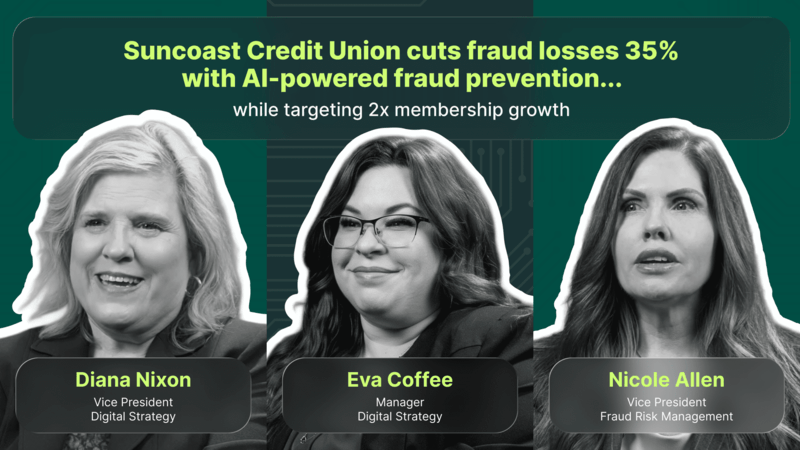
Good members were getting delayed, denied, or stuck in manual reviews because Suncoast Credit Union lacked confidence in the signals behind each decision. That uncertainty slowed onboarding and blocked the rollout of features like real-time payments, where a fraudulent transaction is nearly impossible to reverse. Suncoast serves 1.37M members across Florida with $20.7B in assets, and is now targeting 2.5M members by 2030, so standing still on fraud controls was not an option.
In 2022, Suncoast partnered with Alloy to orchestrate identity, device, and fraud signals across onboarding and ongoing account activity. The platform shifted the Credit Union from reactive fraud detection to real-time decisioning. Device intelligence helped identify suspicious actors earlier and reduce account takeover attempts before they progressed. The system also handled seasonal “snowbirds” whose locations change without triggering false alerts.
Suncoast used Alloy’s Testing Suite to evaluate different KYC data sources, increasing auto-approved applications by 6.47% in digital and 7.09% in-branch. The system now auto-decisions on 98% of login events across 22M monthly logins. Over 103,000 digital products were opened through the platform. Fraud losses dropped 35% YoY while membership grew 8.25% in 2024.
The real-world test came during Hurricane Milton in October 2024. Bad actors spiked account takeover attempts while members dealt with the disruption. Alloy flagged the pattern, Suncoast tightened checks immediately, and digital channels stayed open for members who needed them most.
Internally, the partnership moved conversations from fear-based risk debates to data-driven ones, making it easier to pitch digital growth to executives and the board. (link)
2) Wescom Financial lifts first contact resolution 34% with Copilot
Your frontline reps don’t know what question is coming next. And when the answer lives in a poorly written procedure buried three clicks deep, members wait, calls get transferred, and new hires quit.
Wescom handles over 1M inbound calls annually across its Southern California operation. About 60% of that volume flows into the contact center. SVP of Remote Service Delivery Hashim Forrester noticed transfer rates were climbing, new hire turnover was too high, and hold times were creeping up. Root cause analysis pointed to the same problem: frontline reps lacked the tools to resolve member requests on the first call.
The team chose Microsoft Dynamics and Copilot as the foundation. But the first rollout failed. Procedures loaded into the system were accurate but written in language Copilot couldn’t break down clearly for reps. The formatting was not intuitive on screen, and adoption stalled.
Wescom went back to the drawing board. They rewrote every procedure in seventh-grade language, created quick reference guide templates, and validated everything with subject matter experts before reloading it into Dynamics. The team also reformatted how answers are displayed on screen, knowing that contact center reps move between screens fast and need information that’s easy on the eyes.
The relaunch changed the game. Copilot now gives reps step-by-step answers while they’re on the phone with a member. Reps who once needed three months of training and nesting can now work a call in a day or two using the tool. Results came almost immediately: first-contact resolution improved by 34% through fewer call transfers, new-hire turnover hit its lowest point in four years, and members waited less because reps found answers faster. Copilot only touches procedures and processes, never account information.
Wescom is now building an AI quality assurance bot that reads call transcripts and scores them against the Credit Union’s internal service scorecard. Today, a small QA team manually scores a random sample of calls. The bot will move that from random sampling to near-total coverage, because every member interaction matters, not just the randomized ones. (link)
3) ChatGPT now connects to 12,000 financial institutions through Plaid
Over 200M people already use ChatGPT monthly for financial questions. Now it can actually see their accounts.
ChatGPT Pro users in the U.S. can now connect bank accounts, credit cards, investments, and liabilities directly through Plaid. The tool pulls balances, transactions, and spending patterns into a dashboard, then answers personalized financial questions using GPT-5.5’s reasoning engine. Intuit integration is coming next.
Users can tell ChatGPT about a savings goal, a planned home purchase, or a loan from a family member. It stores that context as “financial memories” and uses it across future conversations. OpenAI plans to expand into credit card recommendations, tax estimates, and scheduling sessions with live tax professionals, all inside the chat window.
Javelin Strategy analyst Dylan Lerner warns that ChatGPT is now positioned to own critical “share of mind” on financial advice, potentially reducing banks and Credit Unions to underlying infrastructure. Basic banking is already being commoditized. This creates a new front of competition for any institution trying to differentiate on advice and engagement.
OpenAI says the tool cannot see full account numbers or make changes to connected accounts. Users can disconnect at any time, and synced data is deleted within 30 days. The company worked with 50+ finance professionals to evaluate accuracy and quality before launch. The feature is starting with Pro subscribers and expanding to Plus users soon, with the goal of reaching everyone. (link) (link)

Tips & Use Cases
Learn to apply AI…
Firefighters First chose Copilot over ChatGPT for long-term fit: CIIO Jeffrey Staw picked Microsoft Copilot because it integrated natively with existing productivity tools and offered a stronger security model. He bet that even at 80% response quality versus ChatGPT, the enterprise architecture advantages would win over five years. His advice to Credit Unions evaluating AI vendors: focus on products and features, not AI branding. (link)
42% of skip-a-pay members still call in despite digital tools: Constant AI CEO Catherine Powers says the average approval rate is 58%, leaving nearly half of members picking up the phone after denial. Her AI voice agent NIA handles those calls in real time using a deterministic core with an agentic shell, freeing back-office teams for complex cases. (link)
AI won’t replace your staff if you lead the transition right: A Credit Union CEO eased employee fears by explaining AI would handle routine calls and repetitive tasks, not replace people. She moved experienced staff into higher-value roles, stopped backfilling open positions, and used natural attrition to resize the team. (link)
How Citi Sky redefines the advisor’s role: Citi’s new AI wealth assistant, built with Google DeepMind, delivers real-time portfolio and market insights through voice at any time. The AI cannot execute trades, keeping human advisors in control for high-stakes decisions while routine interactions shift to continuous, always-on availability. (link)
97% of bank AI cloud pilots reach full production: A Coleman Parkes study found 28% of banks ran AI agents in cloud operations in late 2025, with 71% expected by the end of 2026. Nearly all banks that completed proof-of-concept trials have been deployed to production, signaling agentic AI is clearing the viability bar in regulated environments. (link)
Sygnum pilots AI agent for live blockchain transactions: The Swiss digital asset bank uses Anthropic’s Claude to execute stablecoin transfers, asset swaps, and lending positions from plain text instructions. Clients sign every action through self-custodial wallets, and private keys never leave their devices. (link)
PwC to train 30,000 staff on Claude: Anthropic and PwC expanded their alliance, deploying Claude Code and Cowork across PwC’s workforce starting in the U.S. Early production results show insurance underwriting compressed from 10 weeks to 10 days and cybersecurity incident response cut from hours to minutes. (link)
22 firms join push to upskill 100,000 fintech and banking workers in AI: Zopa Bank and ClearScore’s Jobs2030 initiative now includes NatWest, EY, and Allica Bank. The free program launches with 12 modules tailored to compliance, engineering, operations, and product roles, with AI coaching powered by Gemini, ChatGPT, and Claude. (link)
Fed runs AI on AWS sandbox to protect policy data: Gov. Christopher Waller says Fed economists use AI models in a secured cloud environment, accepting slightly older tools to prevent sensitive information leaks. The central bank already uses AI to summarize meetings and generate minutes faster. (link)
39% of bank engineers’ weeks spent debugging AI code: A Lightrun survey found finance engineers lose over two days weekly fixing AI-generated output. Developers often can’t diagnose code they didn’t write, and silent errors can take weeks to surface. Banks publicly report productivity gains but rarely count the downstream debugging costs. (link)
Boulder Dam Credit Union cuts report time from 10 minutes to seconds: The Credit Union is piloting Fiserv’s new agentOS, an agentic AI operating system co-developed with OpenAI and AWS. Fiserv built the platform with bank-grade controls, kill switches, and human-in-the-loop governance across four AI agents co-created with six bank partners so far. (link)
AI handled two-thirds of one small FI’s call volume: Citi’s Driss Temsamani shared that a $400M institution used AI in its call center to absorb two-thirds of inbound calls. Leadership then removed time limits for remaining calls, empowering staff to spend more time on complex member questions. (link)
KPMG gives all 276,000 employees access to Claude: The global alliance with Anthropic embeds Claude inside KPMG’s Digital Gateway platform, where tax agents that used to take weeks to build now take minutes. KPMG also becomes Anthropic’s preferred partner for deploying Claude into private equity portfolio companies. (link)
73% of banks say AI fluency is their top skill need: American Banker’s survey of 206 banking professionals ranked understanding how AI tools work first, critical thinking second at 64%, and pure coding skills last at 24%. Credit Unions were twice as likely as national banks to flag change management as a critical gap. (link)
Deutsche Bank cuts vendor reviews from 3 hours to 30 minutes with AI: The bank’s TPRM AI uses sequential agents to assess third-party vendor documents against its control framework at 90% accuracy. A manual review of one evidence document takes 30 minutes. The AI analyzes up to five in under two minutes, with human assessors making the final call. (link)
How to bring AI skeptics on board at your Credit Union: Narmi’s Vivek Sanghvi says to skip the kitchen-sink demo and anchor AI pitches in existing pain points like call volume or repetitive back-office tasks. Start with 1-2 low-risk use cases, write clear AI usage rules, and let staff review every output before it reaches a member. (link)
Banning AI may increase risk through shadow usage: SynthWise co-founder Ben Sheedy warns that blocking AI tools pushes employees toward unmonitored workarounds outside official systems. He identifies three adoption silos holding organizations back: over-reliance on one vendor, inability to scale individual productivity gains across teams, and reluctance to connect sensitive data to AI. (link)
Big banks patch vulnerabilities in days after Mythos AI finds them: Anthropic’s Claude Mythos is helping JPMorgan, Goldman Sachs, Citi, and others uncover IT weaknesses buried in legacy code, linking low-risk flaws into serious threats. Larger banks are sharing findings with smaller institutions that cannot afford access to the tool. (link)
AI models disagree on which jobs AI will replace: An NBER study asked ChatGPT-5, Gemini 2.5, and Claude 4.5 to rank occupations by AI exposure. Claude rated accountants highly vulnerable, while Gemini did not. Researchers recommend comparing results across multiple models instead of relying on any single system. (link)
Bank CEO’s AI clone delivered 30 minutes of an earnings call: Customers Bank revealed halfway through its investor call that an AI agent had handled the prepared remarks, then announced a multi-year OpenAI deal embedding engineers inside the bank. Cornerstone’s Ron Shevlin argues the real AI agent payoff is speed, not headcount cuts, with processes that take weeks shrinking to minutes. His warning: banks should not lock into one AI provider this early in the market. (link)
Only 50% of firms can show any measurable AI value so far: IDC research found most AI deployments are “broad but shallow,” with half of organizations unable to point to any business results at all. BBVA and Goldman Sachs are betting $4B+ on OpenAI’s DeployCo to close that gap, embedding AI consultants directly into enterprise workflows. (link)
4 AI marketing moves every Credit Union should run now: Jim Marous says 75% of banks still market like it’s the 90s. His playbook: use AI to find micro-cohorts based on real-time behavior, personalize around the customer instead of the account, deploy predictive analytics to tie marketing to revenue, and check whether AI search tools even mention your institution. (link)

Funding Spotlight
Where the money is flowing for innovation…
Primer raises $100M Series C to apply AI to every payment: The London-based fintech captures 400+ data points per transaction across a merchant’s full payments lifecycle. Sofina led the round with Peak XV Partners, Balderton, Accel, and Tencent participating, bringing total funding to $170M. (link)
Moment raises $78M Series C for AI-powered wealth management OS: Index Ventures led the round, 10 months after leading the Series B. Firms managing over $10T in assets now use the platform, including Edward Jones, LPL Financial, and Hightower Advisors. Moment replaces fragmented legacy tools with a single system where AI agents handle trading, compliance, and portfolio management. (link)
White Circle raises $11M to monitor AI systems in real time: The platform scans AI inputs and outputs to catch hallucinations, prompt injections, data leaks, and model drift, enforcing company-specific policies across 150 languages. Backers include leaders from OpenAI, Anthropic, Mistral, DeepMind, and Hugging Face. (link)
Greenboard raises $20M to automate securities compliance with AI: The platform serves 500+ financial institutions, replacing fragmented legacy tools for employee compliance, communications surveillance, and marketing review. Client Root Financial reclaimed 24 hours per week on manual tasks, while JMG Financial Group cut compliance onboarding time by 60%. (link)
Transient.AI raises Series A for institutional trading AI platform: NEXT Investors backed the AI operating system that unifies front, middle, and back office trading workflows into a single interface with built-in compliance and audit controls. The funding will support global expansion across the Americas, EMEA, and APAC. (link)

Keeping up with Tech
The latest in fintech and tools…
Fiserv launches agentOS for banks and Credit Unions: The agentic AI operating system, built with OpenAI and AWS, lets institutions run Fiserv-built agents, build their own, or deploy third-party options under unified governance and audit controls. Boulder Dam Credit Union is already piloting the platform, cutting daily report times from 10 minutes to seconds. (link)
Google adds Klarna and Affirm BNPL to AI shopping checkout: Google Pay users shopping through Gemini or Google Search AI mode will soon see installment options from both providers at checkout. The integration runs on Google’s Universal Commerce Protocol, embedding flexible payments directly into conversational AI shopping. (link)
Google launches Gemini 3.5 Flash for agentic workflows: The model delivers frontier-level intelligence at 4x the output speed of competing models, designed for complex multi-step tasks like coding, financial document preparation, and data analysis. Banks and fintechs testing early are automating workflows that previously took weeks. (link)
5 more Google announcements Credit Union leaders should know: Search agents monitor any topic 24/7 and send synthesized updates. Universal Cart embeds AI-powered payments across Search, YouTube, and Gmail. SynthID verification for AI-generated content hits 50M uses. AI Inbox drafts contextual email replies automatically. Gemini Spark acts as a personal AI agent that works in the background even when your device is off. Google announced 95 more. (link)
OpenAI adds invisible watermarks to AI-generated images via Google SynthID: All images from ChatGPT, Codex, and the OpenAI API now carry both C2PA metadata and embedded pixel-level watermarks that survive screenshots, resizing, and format changes. OpenAI also launched a public verification tool to check whether an image was AI-generated. (link)
OpenAI brings Codex to mobile for on-the-go coding: Over 4M people now use Codex weekly, and the agent can now run from your phone while connected to laptops or remote environments. Users can review outputs, approve commands, and redirect work in real time. Enterprise teams get HIPAA-compliant support, programmatic access tokens, and remote SSH. (link)
Anthropic consults religious and philosophy scholars to shape Claude’s ethics: The company held dialogues with clergy, ethicists, and scholars from 15+ traditions to inform how Claude’s character is trained. One experiment gave Claude a tool to pause and recall its ethical commitments mid-task, which reduced misaligned behavior on internal evaluations. (link)
Anthropic launches Claude for Small Business with 15 ready-made workflows: The package connects Claude to QuickBooks, PayPal, HubSpot, Canva, and Docusign to handle payroll planning, monthly closes, invoice chasing, and campaign creation. Anthropic partnered with PayPal on a free AI fluency course and is touring 10 U.S. cities with hands-on workshops. (link)

In Other News
Related news you can learn from…
Only 17.7% of organizations are truly AI-ready (link)
DCUC wants Congress to protect CUs from AI fraud (link)
IMF warns AI cyberattacks could become systemic risk (link)
UK regulators warn frontier AI could crack cyber defenses (link)
White House orders regulators to streamline fintech and CU charter processes within 180 days (link)

Community Corner
Memes and visuals…

Thanks for reading!
Until next week,
— Credit Union AI Guy
Enjoying this newsletter? Forward it to a colleague who might appreciate practical AI insights.
Have a question or want to share your own AI experiment? Reply to this email or connect with us on LinkedIn. We’re building a community of curious Credit Union professionals. Come join the conversation!