


What are members who left your Credit Union searching for?
I’ll give you a hint: Younger members are especially seeking this (see story #2 for answer). 😉
This week, I cover:
Navigant Credit Union processes 140 credit card apps in 86 minutes on day 1 of new program
AI is a top priority of members who left a Credit Union
CPM Federal Credit Union cuts agent calls 20% by ditching Legacy IVR
Read time: 9 minutes

Top Stories
The biggest news this week…
1) Navigant Credit Union processes 140 credit card apps in 86 minutes on day 1 of new program
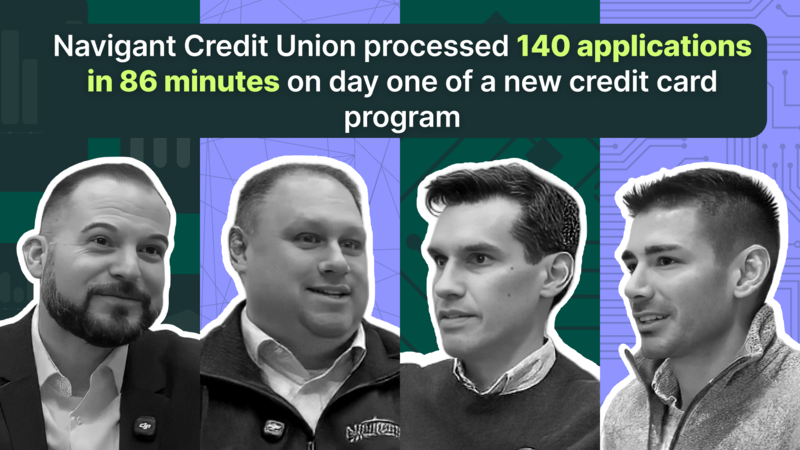
Joseph D. Green, VP and Head of Consumer and Business Credit Card, walked into a branch on his first day at Navigant Credit Union and asked staff to take a credit card application in front of him. The existing LOS served up a 14-page form. “It was like I had to give a blood sample to apply for a credit card,” Green said. That experience triggered the search for a replacement.
After vetting 15 to 18 providers and eliminating most by the third question, Navigant Credit Union selected Fuse, an AI-native LOS. Green identified 3 deciding factors: 1) a seamless member-facing application experience, 2) built-in fraud prevention through OTP verification tied to core and device data, and 3) API integrations that connected existing vendor partners without friction. Keeping the application and LOS under one roof was also critical. Separating them, Green said, would have doubled the implementation timeline.
On day one, Brian Bouvier, VP of Indirect and Consumer Lending, and the team opened the floodgates. The system flawlessly processed 140 applications in 86 minutes with only five requiring manual review. Automatic declines, member emails, and auto-bookings all ran without manual intervention. “We didn’t add new people,” Bouvier said. “We added a new system that was going to complement the team.”
Green described the member and employee response as unanimous: the new application experience was seamless, simple, and fast compared to anything still running on the legacy platform. Bouvier said performance met -– and by his measure exceeded — expectations.
Looking to the future, Bouvier noted that Navigant has set a goal of reaching $7B in assets (from ~$4B) and has invested in a robotic process automation department to support that growth. “We’re not gonna get there doing everything manually,” he said. (link) (link)
2) AI is a top priority of members who left a Credit Union
What if the members who already walked out your door are trying to tell you exactly how to win them back? A new PYMNTS Intelligence report surveyed 13,918 consumers and 500 Credit Union executives and found a striking signal buried in the churn data: members who left a Credit Union are 122% more likely than the average consumer to want AI chat support.
Credit Unions have historically competed on rates, community ties, and personal service. But the 2026 Credit Union Innovation Readiness Index, produced in collaboration with Velera, reveals that those advantages are no longer enough on their own. Digital friction and the absence of AI-powered service are now driving members out the door and toward institutions that offer them.
The consequences compound across generations. Gen Z members, the generation Credit Unions must win to survive future decades, are 73% more likely than the average consumer to want AI-powered financial advice and 69% more likely to want AI chat support. Meanwhile, millennials are 57% more likely to want AI chat support. These preferences are becoming the baseline expectations of the members Credit Unions are competing the hardest to attract and retain.
Yet the current state of AI deployment across Credit Unions tells a different story. Only 20% of top-tier Credit Unions currently offer a conversational AI assistant for payments. Only 22% offer one for financial management. Among emerging-tier institutions, projected AI chat support coverage reaches just 37% by the end of their planning horizon, meaning more than 60% of emerging-tier Credit Unions would still not offer the feature most urgently requested by churned members.
The CUs closing that gap fastest are strategically partnering with vendors, rather than trying to build AI capabilities from scratch. Half of the innovation leaders are partnering with vendors to roll out AI-powered member experiences. And 73% of top-tier CUs are already developing new payment features through external partnerships. (link)
3) CPM Federal Credit Union cuts agent calls 20% by ditching Legacy IVR
Imagine if your contact center got 20% more efficient without ever trying to reduce calls. That’s exactly what happened at CPM Federal Credit Union after CEO James Gergen and Regional VP Colby Tharpe replaced their legacy IVR with Posh, a conversational AI platform. “Our goal was never call avoidance,” Gergen said. “It was to meet members where they want to be met and how they choose to engage.”
Before Posh, CPM’s contact center looked like most. Rigid phone menus locked agents and members into outdated workflows, after-hours support was limited, and high volumes of repetitive calls consumed staff time. Call volume had been flat for years. Then six months after launch, agent-handled calls dropped 20%.
CPM launched Penny, an AI assistant built on Posh that handles more than 100 member intents. Instead of navigating menus, members now hear a simple question: “How may I help you?” Members could get answers instantly. And now, nearly 30% of interactions happen outside of business hours, eliminating next-day callbacks before they happen.
As routine calls shifted to Penny, agents moved to higher-complexity conversations. Handle time increased by design. With fewer repetitive calls, staff used the freed time to cross-train, shadow other departments, and build broader institutional knowledge. Headcount was reduced naturally through attrition, not layoffs.
Following the rollout, CPM grew assets faster than compensation and benefits costs, something Gergen described as historically difficult. The Credit Union is now expanding its Posh deployment beyond the contact center, building a unified knowledge base covering FAQs, policies, procedures, and internal information accessible by branch staff and teams across the organization. (link)

Tips & Use Cases
Learn to apply AI…
CoVantage CIO on AI, data, and the “wrap the core” strategy: Sean VanHandel, CIO of the $4.1B CoVantage Credit Union, says AI agents are now live across back and front office operations, with human-in-the-loop guardrails in place before any full automation. He warns Credit Unions not to rush AI before cleaning their data first: “Bad data in, you get bad data out.” (link)
Alliance Catholic Credit Union automates loan recapture with AI: The Credit Union is implementing ShiftMate to detect when members are financing loans elsewhere and automatically trigger outreach with pre-approved offers. The platform unifies fragmented data into a single member profile, giving frontline staff the context they need to recapture relationships before they’re lost. (link)
Arizona Financial Credit Union trains staff for AI-augmented branches: As routine transactions shift to digital channels, President and CEO Amy Hysell launched Arizona Financial University to build employee confidence in advisory and relationship roles. She addressed staff anxiety around AI directly, framing the investment as augmentation rather than replacement. (link)
AI should price payments around real behavior: Moov founder Wade Arnold argues Credit Unions should use generative AI to build a different digital experience for every member, pointing to Cash App as the model. He also expects AI to replace blunt payment risk categories like merchant code with real-time behavioral data, letting issuers price transactions individually and underwrite suspicious ones instantly rather than declining them. (link)
Firelands FCU deploys AI translation tools in two branches: The $509M Credit Union is rolling out Traduality’s Fire Lingo platform in its Norwalk and Sandusky branches, letting staff hold real-time conversations with non-English-speaking members without hiring multilingual employees or waiting for interpreters. A second tool extends the same capability to multilingual marketing and financial education materials. (link)
NCUA maps out AI and digital asset strategy through 2027: The agency’s new 2026-2030 Strategic Plan formally embraces AI, digital assets, and a lighter supervisory framework, while Chairman Hauptman confirmed the internal reorganization will complete by end of 2027 after more than 1 in 5 NCUA employees accepted buyouts. (link)
Abrigo outlines how Credit Unions can move AI from pilots to operations: Ravi Nemalikanti, Abrigo’s Chief Product & Technology Officer, says Credit Unions create durable AI value only when they embed it directly into core workflows like lending, fraud monitoring, and member service, not just isolated pilots. He recommends defining clear ownership, measurable outcomes, and escalation paths before scaling. (link)
Fifth Third’s lending head says AI lets banks out-code their vendors: Jay Plum, EVP of consumer lending at Fifth Third Bank, says AI tools that make developers 5 to 10 times more productive could let financial institutions build custom experiences that rival what core vendors offer. He also expects AI to replace annual exam scrambles with continuous “mini reviews” run nightly or weekly. (link)
Australian regulator warns AI is supercharging investment scams: ASIC took down nearly 12,000 phishing and investment scam websites in 2025, a 90% increase over the prior year, as scammers use AI to create polished fake ads, professional videos, and fake endorsements. Australians lost $2.18B to scams last year, with investment scams alone accounting for $837.7M. (link)
Claude Mythos sparks emergency meeting with top bank CEOs: Treasury Secretary Scott Bessent and Fed Chair Jerome Powell convened senior financial regulators and CEOs from Citigroup, Morgan Stanley, Bank of America, Wells Fargo, and Goldman Sachs to assess risks from Anthropic’s new model, which has already identified thousands of previously unknown software vulnerabilities. Anthropic has restricted access to a small group, including Microsoft, Nvidia, and Cisco, under Project Glasswing, providing $100M in credits to patch vulnerabilities before broader exposure. (link)
Lloyds Banking Group adds AI agent to its boardroom: The bank is piloting Board Intelligence’s “board bot” to help executives analyze confidential materials, prepare for meetings, and reduce human bias in decision-making. The tool covers cybersecurity, financial analysis, and M&A guidance, with plans to eventually have it participate in live board discussions. (link)
AI fraud detection closes gaps manual review misses in auto lending: TransUnion data puts the average fraudulent auto loan loss at $19,600, with synthetic identity fraudsters alone holding $1.8B in automotive credit access at mid-2025. AI-powered tools like Ocrolus Detect now evaluate document integrity and cross-reference signals across applications to catch coordinated fraud rings before deals fund. (link)
Posh outlines a 3-phase AI adoption path for banks: The crawl phase focuses on internal tools like employee knowledge assistants to build data and governance confidence, the walk phase expands to human-in-the-loop contact center support, and the run phase deploys customer-facing AI agents across voice and chat. (link)
Voice AI cuts burnout and turnover in Credit Union contact centers: WEOKIE Federal Credit Union automated 66% of incoming calls with voice AI, stabilized its contact center at 17 agents, and saved over $800K in a single year. Great Lakes Credit Union went further, shifting agents into consultative roles with higher pay grades after their AI agent “Olive” automated 60-70% of calls during business hours. (link)
Two-thirds of banks rely on informal AI training as agentic commerce grows: American Banker research finds most banks are using on-the-job training rather than formal programs, even as McKinsey projects U.S. agentic commerce could top $1T by 2030. Credit Unions need staff who can evaluate AI agent transactions, authenticate agentic purchases, and spot fraud patterns that look nothing like human behavior. (link)
Visa says AI alone no longer stops modern fraud: Aman Cheema, Visa’s VP of global risk and security intelligence, told PYMNTS that criminals now use the same AI tools as fraud teams, making AI a baseline rather than an advantage. The real edge now comes from behavioral analytics, cross-institution intelligence sharing, and human analysts who spot emerging patterns before automated systems catch up. (link)
DCUC adds Scienaptic AI to its Premier Circle Program: The Defense Credit Union Council has partnered with Scienaptic AI to bring its AI credit decisioning platform to Credit Unions serving military and veteran communities. The platform evaluates borrowers using data beyond traditional credit history, helping Credit Unions assess members whose scores may be affected by deployments and frequent relocations. (link)
88% of companies now piloting AI, but most haven’t scaled: A McKinsey survey of nearly 2,000 companies found AI piloting jumped from 55% in 2023 to 88% in 2025, yet two-thirds have not scaled it across their operations. In investment advisory specifically, 60% of advisers now use AI internally but only 1% have applied it to complex client engagements like delivering investment advice. (link)
Scotiabank launches Scotia Intelligence to unify enterprise AI: The bank’s new platform handles over 40% of contact center queries automatically and processes about 90% of commercial emails through AI document automation, cutting manual work by 70%. Branches and contact centers were first to adopt the tools, with agentic AI capabilities planned for future rollout. (link)
A 3-step path to conversational banking: Shane Ferrell, VP of Product Strategy at CSI, says Credit Unions should start by adding ChatGPT-style interactions that let members ask questions about their spending, expand to AI assistants that handle routine service requests, then layer in predictive tools like proactive overdraft alerts before issues arise. (link)
CIMB Niaga deploys two AI agents for relationship managers and contact centers: Built on Google Cloud’s Vertex AI platform, one agent synthesizes market data and client life milestones to give relationship managers real-time advisory context, while a second surfaces relevant product and policy details to contact center staff during live interactions. Both agents draw from a private internal knowledge base rather than public data to stay compliant with local regulations. (link)

Funding Spotlight
Where the money is flowing for innovation…
Fuse raises $25M Series A to bring AI-native LOS to Credit Unions: The startup is offering the first 50 qualifying Credit Unions free access to its platform until their legacy contracts expire, backed by a $5M rescue fund to cover switching costs. Fuse already has over 100 customers and counts Footwork, Primary Venture Partners, and Commerce Ventures among its Series A investors. (link)
Round raises $6M Seed to automate treasury, payments and payroll: The AI finance platform has processed over $500M in transactions since launching its first automated workflows less than a year ago, working with customers including Cleo and PostHog. New products include an Agentic Workflow Builder that lets finance teams describe automation in plain English and an Autonomous Payroll tool that handles payroll end-to-end. (link)
Variance raises $21.5M Series A to automate risk and compliance investigations: The AI risk intelligence platform, founded by former Apple engineers, processes over 70M context signals per day and executes around 300,000 automated enforcement actions across transaction monitoring, KYC, and customer due diligence workflows. (link)

Keeping up with Tech
The latest in fintech and tools…
Nymbus launches MCP server to connect AI assistants to core banking: The server gives Credit Unions a secure, standardized way to let AI assistants perform 19 banking actions, including customer lookup, account management, and debit card controls, through a single conversational interface. Institutions control which tools are enabled, which roles can access them, and where human approval is required. (link)
Fingerprint adds AI scoring to its device intelligence fraud detection platform: The upgraded Suspect Score lets enterprise fraud teams train a machine learning model on their own labeled fraud data, automatically adjusting signal weights to reduce false positives without manual tuning. Teams can preview all recommended changes before applying them with a single click. (link)
Oracle embeds AI agents into its financial crime and compliance platform: The company secured rights to Lucinity’s AI investigation technology, which will surface relevant case context, automate manual steps, and guide next-best actions for compliance investigators within Oracle’s existing FCCM platform. The new capabilities are expected to be available within 12 months. (link)
OpenAI acquires personal finance app Hiro in talent deal: The startup, backed by Ribbit and General Catalyst, helped users model financial what-if scenarios and claims to have managed planning for over $1B in assets before shutting down new signups. The acquisition follows OpenAI’s October purchase of personal finance app Roi, signaling a push into consumer financial tools. (link)
Revolut launches AI assistant for in-app money management: AIR lets users check spending insights, track investments, manage subscriptions, and freeze lost cards through a single conversation rather than navigating menus. The assistant is rolling out to UK customers first, with travel budgeting and eSIM purchases also handled in-app. (link)
Basware launches AI agent certification program for finance teams: The course trains accounts payable professionals to manage, guide, and override AI agents handling tasks like data extraction, invoice coding, and routing. Available to all Basware customers globally on May 11th, the program covers what AI can and cannot do, which tasks stay human-owned, and how to build confidence in AI-driven workflows. (link)
Coadjute deploys AI digital human to guide property AML checks: Clara walks buyers and sellers through anti-money laundering document collection in real time, operating 24/7 to support international buyers in different time zones. Every check Clara completes is still reviewed and signed off by a qualified compliance professional before the process is finalized. (link)
Kyndryl launches AI digital twin to fix workplace tech issues before they happen: Built on Microsoft Foundry, the platform continuously monitors employee devices and applications, automatically triggering alerts and dispatching support before systems freeze or fail. IT teams get a unified view of workplace performance across offices and regions without tracking individual employees. (link)

In Other News
Related news you can learn from…
Agentic AI is reshaping SaaS into outcome-driven systems (link)
AI and crypto scams drive 59% surge in real estate cybercrime losses (link)
54% of organizations now actively deploying AI agents, up from 12% in 2024 (link)
How banks can deploy autonomous AI agents for measurable growth outcomes (link)

Community Corner
Memes and visuals…

Thanks for reading!
Until next week,
— Credit Union AI Guy
Enjoying this newsletter? Forward it to a colleague who might appreciate practical AI insights.
Have a question or want to share your own AI experiment? Reply to this email or connect with us on LinkedIn. We’re building a community of curious Credit Union professionals. Come join the conversation!