


Your people are the best part of your member experience.
But they’re also your biggest bottleneck when calls pile up or timely campaigns get stuck in review.
This week, I cover:
OnPath FCU cuts abandoned calls 74% after chaotic merger
How Credit Union marketing teams can cut compliance approvals by 90%
ELGA Credit Union mines member data for smarter auto loans
Read time: 9 minutes

Top Stories
The biggest news this week…
1) OnPath FCU cuts abandoned calls 74% after chaotic merger
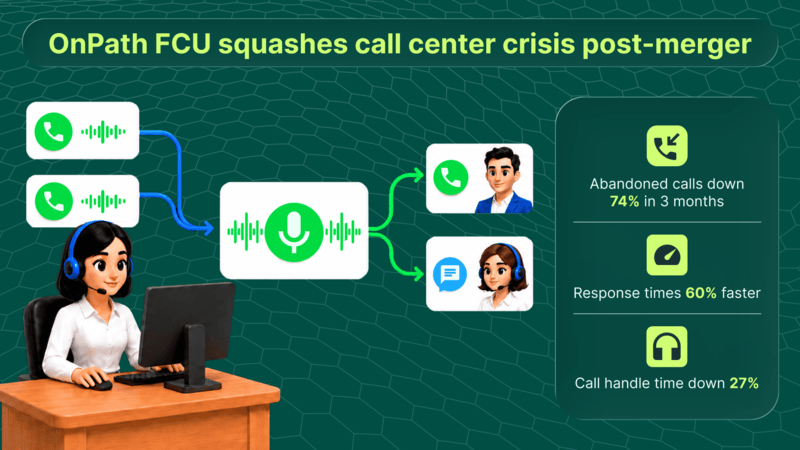
A merger flooded OnPath Federal Credit Union’s phone lines with thousands of new members who all needed help at once, and the contact center buckled.
The merger with Louisiana Federal Credit Union triggered a core system conversion that overwhelmed OnPath’s contact center. Thirty different phone numbers routed inconsistently. Members had to navigate massive IVR trees just to reach a human for simple tasks like checking a balance. Every IVR update required a vendor ticket, so the team couldn’t make real-time adjustments during peak demand. Call abandonment hit 21.4%.
So, OnPath chose Eltropy Voice+ and completed a full platform conversion in a speedy three months. The system rebuilt the IVR from the ground up with skill-based routing, priority queues, real-time dashboards, and a callback option so members never sit on hold. Routine high-volume calls now resolve before a member ever joins the agent queue. Jon Sulfsted, Director of Enterprise Applications at OnPath, called it the most seamless rollout of his career across roughly 50 system conversions. The team trained through Eltropy’s Zendesk knowledge base on their own schedule and adapted the materials for internal use.
Call abandonment dropped from 21.4% to 5.4% (a 74% drop). Average wait time fell 60%, from over five minutes to under two. Call handle time dropped 27%, from 5.5 minutes to 4 minutes.
OnPath also shifted disposition tracking away from IVR button presses and into agent hands. Staff now tag every call with the actual reason a member reached out using Eltropy’s After-Call Work feature. That gives the Credit Union 100% accurate data on member intent for the first time. Sulfsted says that data is already shaping what to automate next: long hold times trigger callback offers, and members applying for loans mid-queue get a text with the application link. (link)
2) How Credit Union marketing teams can cut compliance approvals by 90%
Credit Union marketing teams are stuck in a bottleneck that costs them weeks of lost time on every campaign. Austin Carroll, founder and CEO of Warrant, says the average financial institution takes four to six weeks to get a single marketing asset through compliance and legal review.
That delay has real consequences. When rates drop or a crisis hits, your members need to hear from you fast. But by the time marketing, compliance, and legal finish passing drafts back and forth, the moment has passed. Carroll saw this firsthand across Capital One, Mercury, and Brex, where even top fintechs struggled to move quickly.
Warrant’s AI compliance agent solves this by letting marketers upload content and get it dynamically checked against federal and state regulations, company policies, and brand guidelines before it ever reaches compliance. The platform identifies which regulations apply based on what the asset is and where it will run. For example, a billboard in Florida for a home lending product gets flagged against Florida-specific rules automatically. When compliance reviews the asset, they see exactly what Warrant found and can make strategic decisions rather than proofreading line by line.
The tool also generates pre-approved social media posts for loan officers and monitors employee posts for regulatory risk. Meanwhile, Carroll says compliance officers at many Credit Unions still track employee social media activity in Excel spreadsheets.
Clients see approval flows go 80 to 90% faster within six months of Warrant, and marketing teams produce five times more content because they stop chasing approvals. The system learns from compliance feedback and, within about three weeks, reflects the institution’s actual risk tolerance. (link)
3) ELGA Credit Union mines member data for smarter auto loans
Most Credit Unions sit on a mountain of first-party member data they never use. At ELGA Credit Union, a $1.5B institution in Michigan, auto loans make up more than half the loan portfolio, and the team decided to stop guessing which members to target.
ELGA partnered with Vertice AI, a platform that analyzes first-party transaction, application, and balance data to identify which members show high propensity for specific products. Instead of blanketing 100,000+ members with the same auto loan email, the platform surfaces who is most likely to act and what message will resonate with them.
The targeting goes deeper than demographics. Vertice reads transaction data to spot members making payments to other lenders, flags potential refinance candidates, and segments messaging by life stage. This way, a 22-year-old recent graduate gets a different offer than a family in their 50s. Mitch Rutledge, CEO of Vertice AI, says the platform gives a small marketing or lending team the power of a data science department without adding headcount.
Zach Eychaner, VP of Digital Experience at ELGA, says the results speak for themselves. When campaigns shifted from broad awareness blasts to precision targeting, the lift in loan production was meaningful, not two extra loans, but enough to move the needle on business results. The team now uses A/B testing and experimentation to refine messaging across channels. (link)

Tips & Use Cases
Learn to apply AI…
PYMNTS finds 77% of Credit Unions faced unauthorized access last year: Fraud now hits every stage of the member journey, from onboarding to transactions. Cybersecurity ranked as the top concern for 56% of institutions for the second straight year, with synthetic identity fraud scaling as generative AI helps criminals pass traditional checks. (link)
Velera execs say AI can personalize Credit Union guidance: Velera’s Denise Stevens and Cody Banks told CU Times that Credit Unions can better engage younger members through digital-first strategies and AI-powered personalized financial guidance. They also noted debit spending is outpacing credit growth as consumers get more cautious with debt. (link)
Chime deploys AI across three pillars to scale: Chime’s head of generative AI says the 9.5M-member neobank uses AI to resolve 70% of support contacts without humans, scale user research from 30 interviews per week to 2,000, cut dispute investigation time by 20 minutes per case, and let engineers ship faster with Cursor and Claude Code. (link)
Lending Club processes 90% of loans with no human touch: Lending Club’s credit officer says AI-embedded verification gives borrowers real-time feedback on uploaded documents, cutting processing time from days to minutes. The company runs 60 production models and 200 experiments across underwriting, fraud, and collections at any given time. (link)
How an AI role-play tool trains Credit Union staff 4x faster: Lemonade LXP’s Banker Coach tool lets Credit Unions build realistic member personas in 5 to 10 minutes. It scores staff on empathy, ownership, product knowledge, and compliance language, then delivers full transcripts with strengths, weaknesses, and coaching recommendations after each session. (link)
3 blind spots Credit Unions should watch with AI: Cornerstone Advisors warns that successful AI adoption can quietly create transparency gaps in decision logic, erode institutional knowledge as systems handle more edge cases, and misalign member experience when automation optimizes for speed over empathy. (link)
JPMorgan says agentic AI is in its “terrible twos”: JPMorgan Chase, AWS, and Allianz executives say the fastest ROI from agentic AI comes from high-volume tasks like KYC onboarding, compliance documentation, and claims processing. AWS’s Sri Raghavan warned that handing agents too much autonomy in high-risk situations can go “spectacularly wrong.” (link)
Anthropic’s Mythos model exposes gaps in bank cyber defenses: DataVisor CEO Yinglian Xie warns that Mythos can find and exploit unknown vulnerabilities faster than human teams can respond. Only about 50 large institutions have defensive access through Anthropic’s Project Glasswing, leaving Credit Unions, community banks, and fintechs exposed. (link)
CoBank plans AI “digital twins” of retiring employees: CoBank is exploring AI interviews with retiring staff to capture decades of lending expertise as digital twin mentors. The $330B bank also deployed an AI knowledge assistant that analyzes hundreds of leasing documents stored in SharePoint and delivers quick summaries. (link)
Citi says only 3% of banks have scaled AI: Citi’s head of digital told American Banker’s Payments Forum that AI can cut problem resolution from days to minutes and improve forecast accuracy by 40%, but most banks are still figuring out how to use it. Pagaya’s CEO warned that bank infrastructure is too slow to support agentic payments on both sides of a transaction. (link)
3 steps to start AI without overcomplicating it: Credit Unions should start where friction is highest, like lending or fraud monitoring, pick 2 to 3 high-impact use cases with clear ownership instead of scattered pilots, and plan for team adoption, not just implementation. (link)
US Bank migrates hundreds of apps to AWS for AI push: US Bank will move hundreds of banking applications to AWS and deploy generative AI across voice, chat, and SMS using Amazon Bedrock and Amazon Nova Sonic. The bank plans to build AI agents across mortgage, credit cards, wealth management, and commercial banking while upskilling staff through AWS training programs. (link)
JP Morgan says AI content has a tell you can spot: JP Morgan Payments’ head of communications says AI should enhance content workflows, not replace the thinking behind them. Fletcher Group warns that every AI-generated piece published becomes training data for competitors, and language that shapes brand voice should stay human-written. (link)
AI may finally make personal finance tools mainstream: Only 10 to 15% of consumers actively manage their finances. Perplexity integrated Plaid, OpenAI acquired PFM app Hero, and Cash App launched an AI money assistant, all betting that natural language will widen the appeal beyond dashboards. (link)
14% of consumers now use AI daily for banking decisions: JD Power found that banking tops all categories for daily AI use, ahead of shopping, dining, and travel. Publicis Sapient warns that banks and Credit Unions risk losing control of the customer relationship as AI becomes the decision layer between members and financial products. (link)
Banks need MCP guardrails before AI agents go live: 3forge’s Andrew George warns that Model Context Protocol gives AI agents direct paths into production banking systems. With 80% of organizations reporting unexpected behaviors like unauthorized access, he says banks should govern MCP through existing entitlement and audit frameworks rather than treating agent access as an exception. (link)
Citi launches AI agent platform used by 80% of staff: Citi debuted Arc, an internal AI agent platform that handles research, synthesis, and meeting prep across business lines. Wealth management teams that spent hours preparing for client meetings now get AI-compiled insights automatically, freeing bankers to focus on advisory work and client relationships. (link)

Funding Spotlight
Where the money is flowing for innovation…
Restive Ventures closes $45M fund for AI-native fintech: Restive’s third fund backs early-stage AI startups rebuilding payments, commerce, and financial operations from scratch. The firm’s track record includes a 6.3x return on Fund I and portfolio company Hiro, which was acquired by OpenAI three months after emerging from stealth. (link)
Herd Security raises $3M to fight AI-driven threats: Aspiron Ventures led the round for Herd Security, which lets security teams use AI to generate tailored micro-training content in seconds from imported policies and compliance frameworks. Gartner estimates 40% of social engineering attacks will target executives and staff by 2028. (link)
Elastics raises $2M pre-seed round for AI prediction market trading: Elastics builds AI agents that give retail traders automated research, execution, and portfolio management on prediction markets. (link)
Pit raises $16M seed to replace manual enterprise workflows: Swedish startup Pit builds custom AI software that automates approvals, email workflows, and spreadsheet-driven tasks for enterprises. (link)
Adfin raises $18M Series A for AI-powered finance automation: Adfin is building an agentic finance platform that automates credit control, late fee calculations, and payment reminders while keeping decisions with humans. (link)

Keeping up with Tech
The latest in fintech and tools…
D&B brings verified risk data into Anthropic’s Claude: Dun & Bradstreet is integrating its Commercial Graph into Claude so financial institutions can build KYB/KYC onboarding workflows in minutes. The integration uses the D-U-N-S Number to verify business identity, map ownership structures, evaluate third-party risk, and generate audit-ready documentation automatically. (link)
Broadridge launches agentic AI with 30% cost savings: Broadridge says its agentic AI is now live across capital markets and wealth management, processing millions of transactions monthly for 40+ clients. The agents handle trade fails, account opening, valuation exceptions, and customer inquiries autonomously while keeping humans in the loop for oversight. (link)
AWS launches first payment system built for AI agents: Amazon Web Services partnered with Stripe and Coinbase to let AI agents autonomously pay for data feeds, APIs, and other agents mid-task. Developers set spending limits per session, and AgentCore handles authentication, routing, and retries without interrupting the agent’s workflow. (link)
Solana and Google Cloud let AI agents pay with stablecoins: The Solana Foundation’s Pay.sh marketplace lets AI agents discover, access, and pay for Google Cloud APIs like Gemini and BigQuery using stablecoin rails. Agents browse endpoints, get live rates, and pay from a Solana balance without needing a Google account or human approval. (link)
Temenos embeds AI agents across core banking products: Temenos launched AI Copilots, agents, and a Conversational Studio that lets banks build digital banking journeys through natural language instead of code. A Tier 1 bank using its FCM AI Agent now automates over 20% of sanctions screening alerts across hundreds of thousands of cases. (link)
OpenAI launches $4B deployment company for enterprise AI: OpenAI created a standalone unit with 150 engineers to embed inside organizations and rebuild workflows around AI. The company is backed by TPG, Goldman Sachs, SoftBank, McKinsey, and Bain, and will acquire firms that accelerate enterprise AI adoption. (link)
OpenAI launches voice models that reason and translate live: OpenAI released three real-time audio models for developers building voice apps. GPT-Realtime-2 can reason through complex requests while on a call, GPT-Realtime-Translate handles 70+ languages live, and GPT-Realtime-Whisper transcribes speech as people talk. (link)
OpenAI releases GPT-5.5-Cyber for security defenders: OpenAI launched a specialized model that lets verified cybersecurity teams run red team simulations, validate exploits, and analyze malware with fewer restrictions. Partners, including Cisco, CrowdStrike, Palo Alto Networks, and SentinelOne, are testing how it accelerates vulnerability patching and threat detection. (link)
Vine launches AI assistant for Credit Union lending: Vine’s new AI Assistant lets lenders ask questions inside a loan file and get answers grounded in uploaded borrower documents. It summarizes financial statements, flags missing information, drafts credit memos, and checks everything against the institution’s own credit policies. (link)
Codat launches AI advisory platform for commercial banks: Codat’s new platform gives commercial banking teams real-time access to business clients’ off-bank financial data and turns it into AI-powered insights for spend analysis, working capital, and FX exposure. BMO is among the first banks using it to personalize middle-market card advisory conversations. (link)

In Other News
Related news you can learn from…
House panel weighs AI fraud bills affecting Credit Unions (link)
Augustus gets OCC approval to build an AI-native clearing bank (link)
OpenAI says frontier firms use 3.5x more AI per worker than typical firms (link)
Alipay AI Pay passes 100M users as shoppers delegate purchases to agents (link)

Community Corner
Memes and visuals…

Thanks for reading!
Until next week,
— Credit Union AI Guy
Enjoying this newsletter? Forward it to a colleague who might appreciate practical AI insights.
Have a question or want to share your own AI experiment? Reply to this email or connect with us on LinkedIn. We’re building a community of curious Credit Union professionals. Come join the conversation!