


The AI conversations that go nowhere always start with: What tool should we buy?
The ones that actually work start with a different question: What problem are our members running into that we still haven’t fixed?
This week, I cover:
Signal Financial FCU uses AI voice printing to catch elder fraud
Red Rocks CU’s AI voice assistant hits 78% solve rate in 6 months
Capital CU’s marketing team saved hundreds of hours with Jasper
Read time: 9 minutes

Top Stories
The biggest news this week…
1) Signal Financial FCU uses AI voice printing to catch elder fraud
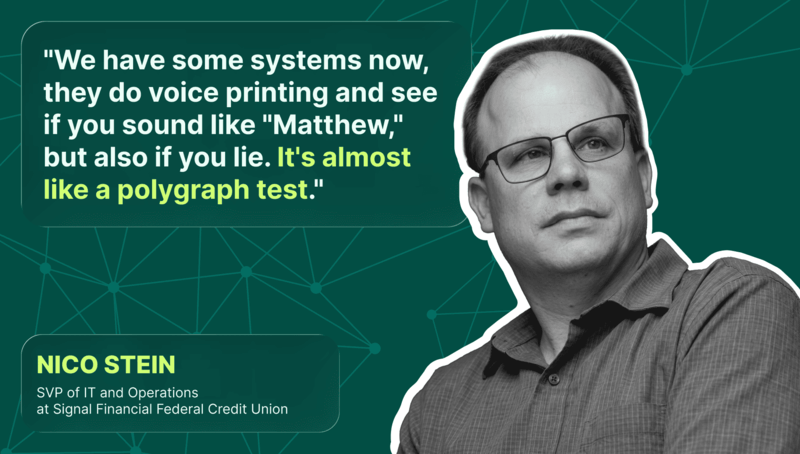
Voice phishing attacks targeting elderly members are surging, and they sound exactly like the real person. AI tools now let criminals replicate a grandson’s voice in 30 seconds, creating panic-driven calls that are nearly impossible for members to detect on their own.
Signal Financial Federal Credit Union, a community-based institution in the DC-Maryland-Virginia area, deployed AI-powered voice printing in its call center to fight back. When a member calls to request a wire or large withdrawal, the system checks whether the caller’s voice matches the member on file. It also monitors for stress indicators, functioning like a real-time polygraph that flags when a caller’s emotional patterns suggest deception. The system is not 100% accurate, but it gives staff a layered set of indicators before approving high-risk transactions.
Nico Stein, SVP of IT and operations, told the board the Credit Union had to stop hoping ransomware would not happen and start assuming it would. He sold the immutable backup investment with one line: the alternative is your name on the Washington Post. Signal Financial onboarded immutable storage through Object First, so backups cannot be deleted even if attackers breach the network.
On AI adoption broadly, Stein starts with a problem, not a product. He warns that vendors are slapping AI labels on basic if-then logic and that agentic AI with MCP servers is his personal security nightmare because of how difficult it is to control data flow. Signal Financial uses Microsoft 365 Copilot for meeting transcripts and email, and is evaluating AI for faster underwriting decisions, but keeps a human in the final approval seat. (link)
2) Red Rocks Credit Union’s AI voice assistant hits 78% solve rate in 6 months
Long hold times and backed-up call queues were eating into member experience at Red Rocks Credit Union. When callers can’t get through, frustration builds, and staff might rush through conversations to clear the line.
CEO Darius Wise, a former pastor with no banking background, came into the role and set three north stars: 1) achieve top-decile NPS, 2) become an employer of choice, and 3) reach $500M in assets. Every tech decision had to trace back to one of those goals.
The Credit Union gutted its entire tech stack over three and a half years, replacing its core, CRM, LOS, online banking, and account opening platforms. Red Rocks moved to KeyStone, an open-API core, and partnered with MANTL for digital account opening, cutting the process to under three minutes. Application drop-off improved by roughly 50%.
For call center pain, Red Rocks launched Roxy, a 24/7 voice assistant built with Interface.ai, in November 2025. In six months, Roxy handled over 9,200 calls with a 78% solve rate, freeing staff to focus on lending and relationship conversations.
Wise started AI adoption with governance and policy before any implementation. Meanwhile, staff were told AI would enable them to focus on personalized member interactions, not replace them. (link)
3) Capital Credit Union’s marketing team saved hundreds of hours with Jasper
Content creation for a 12-person Credit Union marketing team can take an entire day, from brainstorming to final copy. Multiply that across every campaign, blog, and ad variation, and the team spends more time writing than executing strategy.
Steve Zich, CMO at Capital Credit Union in Green Bay, Wisconsin, rolled out Jasper about two years ago after hearing how a CMO in another industry used it to scale content output. Early adoption was slow because the team worried AI was robbing them of their creativity. Zich reframed it: treat Jasper like an AI twin sitting across the table, not a replacement. You start the draft, then riff back and forth to go deeper and broader.
Over the first year, the team saved a couple of hundred hours on content creation alone. That freed capacity to run more campaigns without adding headcount. Zich’s line to the team: a tool like this lets a team of 10 feel like a team of 20.
The Credit Union also layered AI-powered targeting on top of member data to drive personalized campaigns. During the CD push roughly a year and a half ago, they combined manual audience segmentation with AI-powered targeting to catch prospects they would have otherwise missed. The result was exponential growth in their CD portfolio during that period.
Zich filters every AI pitch through three questions: 1) Does it solve a real member pain point? 2) Can it scale with measurable ROI? 3) Does it align with organizational strategy? If a vendor conversation is all about the technology and not about the member, he treats it as noise. (link)

Tips & Use Cases
Learn to apply AI…
Carter Credit Union deploys AI across 6 functions: Voice AI, chat AI, knowledge assist, Zest AI for lending, BioCatch for fraud detection, and LemonadeLXP for training content. The Credit Union is using attrition rather than layoffs, reducing its contact center staff from 20+ to 13 while freeing agents to handle higher-value member calls. (link)
Empower Federal Credit Union uses AI to scale member service: The FCU deployed Glia’s platform with a virtual assistant named Emmy and IllumaSHIELD voice verification to reduce friction and provide 24/7 support. The response-based AI lets the Credit Union control conversations while expanding service beyond its physical footprint into new time zones. (link)
Best frontier LLM still gets 1 in 3 fraud risk ratings wrong: FinCrimeBench tested 110 expert-curated prompts across fraud and AML scenarios, with the other three providers scoring just 46% to 53% accuracy. Errors spiked on operational decisions like risk level assessment, where models produced confident rationale that was wrong in the direction that matters most. (link)
Your Credit Union may be invisible to AI search: eMarketer’s AI Visibility Index analyzed thousands of ChatGPT responses across nine banking categories. Capital One was named in 62% of credit card answers. LLM searches are growing 150% YoY versus 20% for Google, and publishers like NerdWallet and Bankrate account for 15% of all cited sources. (link)
Pinnacle Financial Partners introduces AI as a teammate, not a threat: The bank’s COO rolled out Microsoft Copilot in a protected environment with simple use cases like email search and report building. Employees started generating their own AI ideas, leading to a new AI executive council to manage the volume of incoming requests. (link)
Rivermark Community Credit Union’s risk chief says AI vendors won’t negotiate liability for model failures: Cirith Anderson, SVP of Risk Management, warns that most AI vendor contracts push all liability for model output onto the subscribing institution. If the vendor’s code produces a wrong result that harms members, the Credit Union has no contractual recourse to recover losses. (link)
Nymbus launches MCP server so AI can connect to banking cores: The core banking provider built an MCP server that lets AI agents authenticate callers and query account data for call center staff. CEO Jeffrey Kendall says write capabilities for end users are coming within six months, meaning members could eventually conduct transactions through ChatGPT or Claude. (link)
How AI document processing cuts manual lending bottlenecks: Document processing automation now extracts and validates paystub, ID, and insurance data in real time, feeding directly into alternative decisioning models without manual entry. Credit Unions can increase approval rates, shorten funding timelines, and layer in fraud detection that catches synthetic identities and deepfakes at scale. (link)
Revolut says AI now outperforms humans in AML monitoring: CEO Cetin Duransoy told a Washington forum that AI transaction monitoring performs “statistically significantly better than human reviews,” freeing investigators for complex cases. Revolut now treats AI as core infrastructure across 39 countries, with every employee using it in some capacity. (link)
UK report finds AI could automate 50% of financial services tasks: The Financial Services Skills Commission found most roles will see 30% to 50% of tasks automated, putting pressure on entry-level positions and reshaping demand toward data, governance, and software skills. By 2035, the sector could lose up to 450,000 of its 780,000 highly skilled workers through turnover or retirement. (link)
Woops, Standard Chartered’s “lower-value human capital” comment backfires: CEO Bill Winters announced 7,000+ job cuts tied to AI adoption and described displaced roles as “lower-value human capital.” The backlash was immediate, forcing an internal memo to reassure staff within 24 hours. The lesson is to position AI around augmentation and member outcomes, not labor reduction. (link)
AI agents are becoming digital employees at banks: Peapack Private CTO John Kowal says his bank now treats AI agents as digital employees that create plans, execute tasks, and adapt on their own. Practical starting points include campaign monitoring agents, automated email drafting from to-do lists, and replacing manual spreadsheet processes, which cut time by at least 50% in one case. (link)
Banks now need to design for AI, not just members: As consumers increasingly ask AI tools for financial recommendations, your data needs to be structured so machines can read it. If your rates, fees, and product details live in PDFs or marketing copy instead of clean structured data, AI agents will skip you entirely when members ask where to bank. (link)
AI search is sending members straight to NCUA complaints: America’s Credit Unions warned that AI-generated search results now present federal complaint channels as a first option, bypassing Credit Union resolution processes. Complaint volumes have jumped from a handful per year to multiple per month, and ACU is asking NCUA to require members to contact their Credit Union before filing. (link)
Dimon says JPMorgan will hire fewer bankers, more AI staff: Speaking at a Shanghai summit, Jamie Dimon said AI will reduce certain banking roles while creating new technology and client-facing positions. He expects the shift to happen through normal attrition, not mass layoffs. Roughly half of U.S. salaried workers have received no workplace AI training in the past year. (link)
Valley Bank CEO says AI fixes fragmentation, not replaces people: Ira Robbins argues banks have quietly carried a platform and process fragmentation problem for decades, and AI is the connectivity layer that finally solves it. When systems talk to each other, employees spend less time on manual reconciliation and more time on the member relationships that AI will never replace. (link)
AI agents now chat with crypto scammers to protect members: Chainalysis deploys AI agents that pose as fake fraud victims to uncover scammer tactics at scale, then passes that intel to financial institutions. AI-powered scams generate an average of $3.2M per operation versus $719,000 without AI, a nearly fivefold gap driven by a 1,400% surge in automated impersonation. (link)
Anthropic’s CFO built the finance workflow every CFO will copy: Anthropic’s CFO Krishna Rao uses Claude to produce monthly financial reviews that arrive 90% to 95% ready, cutting weekly reporting from hours to 30 minutes. The company also shipped 8 pre-built finance agents for small businesses covering invoicing, payroll, month-end close, margin analysis, and contract review. (link)
TD Bank cuts mortgage pre-adjudication from 15 hours to 3 minutes: The bank’s AI R&D lab built agentic AI that classifies documents, extracts income data, validates figures against policy, and generates summary memos for underwriters. TD has mapped plans to bring AI into every step of secured lending as part of an enterprise strategy designed to generate $1B in annual value. (link)

Funding Spotlight
Where the money is flowing for innovation…
Ocean raises $28M to fight AI-driven email threats: The agentic email security platform uses autonomous AI to investigate every incoming message rather than flagging suspicious signals. Ocean already defends hundreds of thousands of mailboxes for enterprise customers, including Fortune 500 firms. (link)
Mercury raises $200M Series D at $5.2B valuation: The startup banking platform now serves over 300,000 customers, including one in three U.S. startups, and reported $650M in annualized revenue. Mercury is building natural language financial workflows and MCP integration so businesses can manage banking programmatically through AI. (link)
Primer raises $100M Series C to build AI payments layer: The unified payments platform captures over 400 data points per transaction and plans to expand its AI agent, Primer Companion, from decision support to autonomous optimization. Primer will use the funding to grow U.S. revenue to a third of the business by 2028. (link)

Keeping up with Tech
The latest in fintech and tools…
Klarna brings 100M products into ChatGPT search: The new shopping app connects ChatGPT to over 100M products and 400M merchant listings across 13 markets. During the 2025 holiday season, traffic from AI platforms to retail sites grew nearly 700%, with those shoppers converting at 31% higher rates. (link)
Ex-Galileo CEO launches AI agent operating system for banks: Derek White’s new startup, Primitive, deploys governed, auditable AI agents with embedded compliance for financial institutions. Early agents include same-day commercial credit underwriting, consumer lending processing cut by 60-80%, and fraud detection with 20-40% fewer false positives. (link)
Experian launches identity verification for AI agent payments: The new “Know Your Agent” framework links verified consumers to AI agents through real-time trust tokens and dynamic trust scoring. Experian is building the system alongside Visa, Cloudflare, and Skyfire to create a layered trust stack as autonomous AI commerce scales. (link)
Gartner names OpenAI Codex a leader in enterprise coding agents: Over 4M people use Codex weekly, with Cisco building the majority of its AI Defense platform using the tool and cutting delivery from quarters to weeks. Recent updates include HIPAA-compliant support and enterprise controls like approval gates and auditable governance. (link)
Google launches Gemini Omni for video creation and editing: The new model generates and edits video from any combination of text, image, video, and audio inputs using natural language conversation. Gemini Omni is rolling out to Google AI subscribers and YouTube Shorts, with API access for developers and enterprise customers coming soon. (link)

In Other News
Related news you can learn from…
AI model reviews could start 90 days before release (link)
Mythos found 10,000+ serious software vulnerabilities (link)
Mythos prompts regulators to delay big-bank cyber exams (link)
Anthropic says AI raises 3 moral questions beyond computer science (link)

Community Corner
Memes and visuals…


Thanks for reading!
Until next week,
— Credit Union AI Guy
Enjoying this newsletter? Forward it to a colleague who might appreciate practical AI insights.
Have a question or want to share your own AI experiment? Reply to this email or connect with us on LinkedIn. We’re building a community of curious Credit Union professionals. Come join the conversation!