


AI is leveling the playing field for Credit Unions with limited resources.
But are you taking advantage of it?
This week, I cover:
Texans CU uses Copilot to scale rapidly across Texas
OceanAir FCU uses Q2 integrations to compete with larger institutions
How a Credit Union tech exec escaped a legacy code crisis
Read time: 9 minutes

Top Stories
The biggest news this week…
1) Texans Credit Union uses Copilot to scale rapidly across Texas
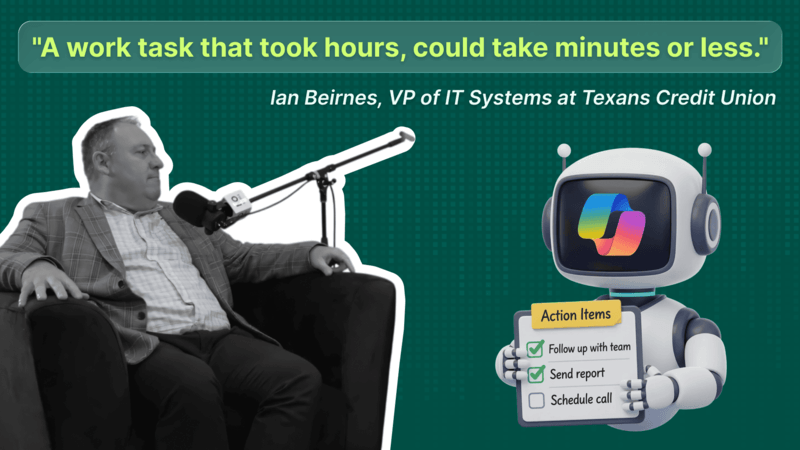
Maintaining aging on-prem systems was consuming significant time and energy at Texans Credit Union, pulling focus away from innovation and automation. With Texans previously focused almost entirely on the Dallas-Fort Worth metroplex, its older infrastructure was not built to support the speed, scale, and digital experience modern members expect.
Backed by CEO David Frazier and the executive leadership team, VP of IT Systems Ian Beirnes helped lead Texans Credit Union’s move to Microsoft Azure and Microsoft 365. The team rolled out Microsoft Copilot with Microsoft Purview’s permissions and labeling controls as a key part of the security model. They blocked all other AI tools entirely so every data interaction would flow through Copilot’s controlled environment. Staff quickly found that tasks that took hours dropped to minutes, particularly for meeting notes, action items, and Excel-based financial analysis.
Texans is currently at about 130,000 members, growing ~10% YoY, and has expanded from the DFW metroplex to all 254 Texas counties. Beirnes used a crawl-walk-run approach to Copilot adoption, helping teams see how the tool applied to their specific jobs so they could become more engaged in the rollout. The Credit Union is targeting near-total cloud adoption by mid-2027. (link)
2) OceanAir FCU uses Q2 integrations to compete with larger institutions

In Q2’s 2026 Retail Banking Trends and Priorities research, 56% of Credit Unions listed digital transformation as a top priority, yet 60% remained in the early stages of implementation.
Members are not comparing their experience to the Credit Union down the street. They compare it to Amazon, Venmo, Chime, and Starbucks.
Jesus Garcia, Chief Experience Officer at OceanAir Federal Credit Union, built the entire digital experience around one operating principle: if a vendor does not already work well inside Q2’s ecosystem, OceanAir moves on. By choosing the right Q2-integrated partners, OceanAir’s department of one can move quickly without needing heavy IT lift.
OceanAir’s digital experience leader previously worked at the Credit Union, spent a couple of years at Q2, and then returned with deeper platform knowledge. Garcia’s team stacked Q2-integrated tools, including Eltropy for lobby appointments and loan status texts, Larky for push notifications, Origence for loan origination, and SavvyMoney for in-app FICO scores. Together, they create a closed loop where a member can check their score, apply for a loan, and get text updates without calling anyone.
On the AI side, OceanAir partnered with Eltropy on an employee assist AI program, loading their new card program and credit card rewards details into the tool so staff can get instant answers during member conversations. They also used data to spot a local advantage: OceanAir is the only financial institution in its county that’s a Visa shop, and Costco accepts only Visa, so the team increased rewards for Costco gas purchases to capitalize on that edge. Garcia also described using AI and member data to launch timely rewards, including refunding a month of Netflix for members paying for that subscription with the OceanAir card. (link)
3) How a Credit Union tech exec escaped a legacy code crisis
Legacy code written in a language with almost no available developers is a ticking clock, especially during a period of restructuring and mergers and acquisitions. If that code breaks, troubleshooting is brutal, and batch jobs that miss their midnight deadline can prevent a Credit Union from opening the next day.
Nupur Daruka, Sr. Director of Software Development at First Tech Federal Credit Union, used Claude and GitHub Copilot integrated directly into the team’s repos to convert legacy code at speed. Before broader adoption, the team created prompt templates, markdown files, and guardrails to reduce the risk of accidentally committing PII.
Adoption started with a small pilot group and expanded after the framework was proven. For AI-driven decisions, her team uses a tiered risk model: low-risk processes run fully automated, while high-risk decisions always keep a human in the loop for auditability. On fraud, her team replaced rule-based detection with a real-time AI vendor integration, replicating transactions to the vendor’s system the moment they occur so the fraud team can act before losses happen. (link)

Tips & Use Cases
Learn to apply AI…
Curql Collective backs AI fraud prevention initiative for Credit Unions: Charm Security and Curql Collective launched the National Member Protection Initiative with five Credit Unions, including InTouch, Lake Trust, and ORNL Federal, to test agentic AI that intervenes before scams cause financial harm. The effort comes as nearly 7 in 10 Americans were targeted by scams in 2025, resulting in an estimated $64B in losses. (link)
How Aliya Financial Technologies runs lending with 5 people instead of 50: The Aliya platform combines cash flow analysis trained on 1.2 trillion transactions, fraud detection, and portfolio optimization into one AI system, cutting loss rates to 2.5% compared to SoFi’s 7% on a lower average FICO score. (link)
How to roll out AI collections safely at your Credit Union: Start with a one to two week design phase covering one loan type and one delinquency segment, run internal simulations for opt-outs and hardship signals, then pilot with a limited member population for two to four weeks before expanding. This matters now as Credit Unions reported 95 basis points in total delinquency in Q3 2025. (link)
True North FCU adopts Scienaptic AI for lending decisions: The Juneau-based Credit Union is deploying Scienaptic AI’s credit decisioning platform to move beyond traditional credit scores and expand access to credit for Alaskan members. (link)
AI agents need the same governance controls as human employees: If a teller cannot approve their own override, neither should an AI agent. Financial institutions entering agentic AI should apply least-privilege access, audit logging, approval hierarchies, and separation of duties before any agent touches member data or initiates actions. (link)
Raddon’s chief economist says AI can close the scale gap: Bill Handel says 8 out of 10 Millennials and Gen Zers would choose a Big Five bank over a Credit Union as their primary institution. The gap is perception and positioning, not product quality, making AI-driven efficiency only half the solution. (link)
Sam Altman says slow AI adopters face a competitive disadvantage: The OpenAI CEO told Cisco’s AI Summit that companies not structured to adopt AI co-workers quickly will fall behind. Altman predicts the end state is “full AI companies” where AI actively participates in how work gets done rather than layered onto existing workflows. (link)
Port Washington State Bank uses GenAI to build campaign playbooks in minutes: Amy Kauper, VP of Retail Banking at Port Washington State Bank, uses GenAI to turn a completed marketing brief into talk tracks, FAQs, objection guides, and manager huddle plans in a single chat session. Starting at 80% instead of zero compresses campaign launch time from weeks to days and keeps frontline staff working from the same playbook. (link)
Joe Pine says AI can help banks shift from experience to transformation: In a Banking Transformed interview, author Joe Pine says AI excels at two things banks need most: building detailed customer profiles from transaction data to surface personalized goals, and coaching members between adviser appointments to keep them on track toward real financial outcomes. (link)
Anthropic research finds no AI unemployment spike yet, but hiring slows for young workers: The study found no measurable increase in unemployment for the most AI-exposed workers since late 2022, but hiring into those roles for workers aged 22 to 25 dropped 14% compared to pre-ChatGPT levels. Customer service representatives rank second-most exposed, at 70.1% task coverage, behind only computer programmers at 74.5%, with financial and investment analysts at 57.2%. (link)
Global illicit finance hit $4.4 trillion in 2025 as criminals weaponize AI: Nasdaq Verafin reports U.S. banks absorbed $179B in direct fraud losses while 63% of organizations faced business email compromise attacks, pushing 75% of anti-financial crime professionals to expand AI-driven detection over the next year. (link)
Credit Union tech IQ at highest level ever: SavvyMoney CEO JB Orecchia told the Fintech Hustle podcast that Gen Z is the platform’s most engaged user, obsessively tracking credit scores, but warned Credit Unions need to catch up on cash flow underwriting as Gen Z builds wealth through debit and buy-now-pay-later instead of traditional credit. (link)
SAS report finds only 11% of banks have trustworthy AI: A global IDC survey of 2,375 IT and business leaders found 47% of banks are either underusing reliable AI or over-relying on unvalidated systems, while 45% lack effective data governance and 42% face AI talent shortages. Banks using AI to improve member experience report $1.83 back for every dollar invested. (link)
96% of financial institutions are using or planning AI: A Finastra survey of 1,000+ leaders across 11 global markets found 43% cite AI as their top innovation lever. Another 54% are leaning on fintech partnerships to accelerate modernization, and institutions expect a 40% increase in security spending as AI scales. (link)
Verity Credit Union used Zest AI to boost loan approvals for members over 62 by 270%: An American Banker op-ed argues AI trained on historical data risks automating inequality. But Credit Unions using fair lending models like Verity’s partnership with Zest AI show purpose-driven AI can expand access with lower delinquencies rather than simply optimizing for profit. (link)
Accenture says “optimize my idle cash” should scare every Credit Union: Michael Abbott, Accenture’s global banking lead, warns that 65% of consumers are open to using a ChatGPT-type financial assistant. Credit Unions that don’t appear in AI-generated recommendations risk losing deposits and loans without ever knowing they lost the opportunity. (link)
How to get more out of GPT-5.4 for financial work: When prompting AI for multi-step finance tasks, define the exact output format upfront, tell the model to verify its own numbers before delivering results, and chain steps into explicit workflows so it knows what “done” looks like. (link)
Microsoft Foundry delivers 327% ROI over three years, Forrester finds: A study of five organizations found the biggest driver of returns was developer productivity, worth $15.7M over three years, as teams using Foundry reduced AI development time by 30% to 40% by building on shared knowledge bases instead of rebuilding pipelines from scratch. (link)
How to set up Claude Cowork as a CFO analyst in 15 minutes: Point Claude Cowork at a dedicated folder with three files: a workspace brief, a task list, and a memory file that stores decisions between sessions. It will ingest contracts, flag spend inconsistencies, and build reusable dashboards without writing a single line of code. (link)
Agentic AI governance starts at the logic layer, not the transaction layer: Once an AI agent initiates payments or routes funds without human approval, monitoring outcomes is already too late. Compliance advisor Natalia Taft says boards need plain-language answers on objective functions, hard limits, drift detection, and kill-switch procedures before any agent goes live. (link)

Funding Spotlight
Where the money is flowing for innovation…
Remitian raises $7M Seed round to automate tax payment and reconciliation workflows: The startup launched a Tax Payment API that lets accounting firms embed payment initiation, real-time tracking, and reconciliation across tax jurisdictions into their existing platforms, replacing manual government portal entries that create penalties and audit risk. (link)
RenoFi closes $22M Series B to scale renovation financing: RenoFi’s AI-powered platform combines credit underwriting with renovation-specific underwriting to unlock After Renovation Value financing, giving equity-light homeowners up to 11x more borrowing power. Credit Union partners include Ardent, Chartway, First Community, and USALLIANCE Financial. (link)
Pasito raises $21M Series A to automate benefits administration: Pasito’s agentic AI platform unifies group health, life, and retirement benefits workflows for carriers, brokers, and financial institutions, achieving 98% accuracy in plan construction vs. the 74% industry average. (link)
Denki raises $4.1M to automate SOX and BSA/AML compliance testing: Its three AI agents map internal controls, validate them in real time against HR and access data, and link general ledgers into a single audit trail that flags issues before they become findings and generates ready-to-share audit packs. (link)
Levitate raises $16M to scale AI relationship marketing: The platform helps finance, insurance, and other relationship-based businesses automate client outreach through email, text, social media, and more, now serving 8,000+ businesses with $71M raised to date. (link)
Vivox AI raises £1.3M to build auditable AI agents for compliance: The UK startup’s atomic AI agents handle AML, KYB, and KYC workflows for regulated financial institutions, with each agent responsible for a single defined task to maintain auditability and regulatory control. (link)

Keeping up with Tech
The latest in fintech and tools…
Upstart applies for national bank charter to expand AI lending: The move would let Upstart lend nationwide under a single regulatory framework and fund more loans with insured deposits, while continuing to sell roughly 95% of originated loans to Credit Union and bank partners. (link)
OpenAI releases GPT-5.4 with native computer use: The model matches or beats industry professionals on 83% of knowledge work tasks and operates desktop software and browsers natively. It uses 47% fewer tokens on complex tool workflows, making it more practical for document-heavy financial back-office work. (link)
OpenAI launches ChatGPT for Excel with financial data integrations: The add-in lets teams build, update, and analyze spreadsheet models in plain language directly inside Excel. Integrations for Moody’s, Dow Jones Factiva, MSCI, and others support workflows like credit memos, valuation, and due diligence. (link)
Apex FinTech and Wavvest partner on AI financial planning: The integration connects Wavvest’s AI planning engine to Apex’s custodial data infrastructure, generating financial plans, tax analyses, and portfolio recommendations in minutes instead of hours of manual entry. (link)
TransUnion launches AI agent to speed credit analytics: Built on Google’s Gemini models within the OneTru platform, the tool translates natural-language questions into governed, production-ready analytical workflows inside TransUnion’s TruIQ suite. It cuts credit analytics cycle times from weeks to hours, allowing financial institutions to run sophisticated analyses without direct data science support. (link)
Mastercard unveils trust layer for AI agent payments: The open-source Verifiable Intent layer creates a tamper-resistant record of what users authorized when AI agents act on their behalf, with Google, IBM, and Checkout.com among early backers. (link)
OpenAI launches Codex Security for AI-powered vulnerability detection: The application security agent builds context about a codebase to identify and patch complex vulnerabilities, cutting false positives by over 50% and reducing noise by up to 84%, giving development teams a faster path to secure code. (link)
Finastra and FraudAverse partner on real-time AI fraud detection: FraudAverse’s AI platform is now pre-integrated into Finastra’s Financial Messaging infrastructure, giving financial institutions real-time fraud monitoring across payment channels without extensive internal development. The companies claim the system can deter up to 99% of fraudulent transactions. (link)
Theta Lake patents AI detection of apps visible during screen shares: The system uses visual and textual fingerprinting to automatically identify software displayed during recorded meetings. Compliance teams at regulated financial institutions get an auditable way to flag accidental exposure of sensitive data. (link)
Rezolve.ai layers agentic AI on top of ServiceNow without replacing it: Credit Union IT teams can add an intelligence layer that handles voice, email, and chat support while reducing ticket volume within 60 days, with a conversational automation builder that constructs full workflows from a plain-language description. (link)

In Other News
Related news you can learn from…
Consumer AI moves from tools to full digital ecosystems (link)
AI productivity gap widens between executives and employees (link)
Fintech founder shares lessons from building and selling an AI startup (link)
AI value comes from sequencing the right business models, not running more pilots (link)
PIMFA, Morningstar, and Finextra launch AI Tech Sprint for wealth management fintechs (link)

Community Corner
Memes and visuals…

Thanks for reading!
Until next week,
— Credit Union AI Guy
Enjoying this newsletter? Forward it to a colleague who might appreciate practical AI insights.
Have a question or want to share your own AI experiment? Reply to this email or connect with us on LinkedIn. We’re building a community of curious Credit Union professionals. Come join the conversation!