


AI can make your team faster and more unified, but only if your data, workflows, and people are ready for it.
Today, I cover:
Volt Credit Union uses AI to fix internal knowledge chaos
Mountain America Credit Union builds an AI-ready workforce through HR
How to deploy AI agents safely without risking member trust
Read time: 9 minutes

Top Stories
The biggest news this week…
1) Volt Credit Union uses AI to fix internal knowledge chaos

At Volt Credit Union, CEO Chris Moss found a call center employee using a 3-inch binder of printed policies that was already outdated. That’s a trap with many Credit Unions. Staff create their own shortcuts when finding the right documentation takes too long. So, they end up saving “final” files to desktops to reuse, even when the material is outdated.
Moss knew the goal was to speed up answers without letting member data or internal policies leak.
The biggest worry was crossmingling between the public widget and internal knowledge. They needed clear separation. So Volt started internal-only, uploaded a small trickle of documents, tested answers, then expanded. They manually chose what went in, kept it a closed loop, and avoided connecting AI to the core or a shared drive. They also segmented content by department to reduce wrong-process mistakes and speed up retrieval.
Results came as speed, exam readiness, and better insight. Most of their questions are answered within five seconds. During an exam, their IT director asked their AI knowledge management tool, “Ask Moxy,” and had an answer in five seconds to send to the examiner. The cherry on top: Weekly question summaries now show what staff and members ask most, flag training gaps, and reveal missing website content to improve self-serve. (link)
2) Mountain America Credit Union builds an AI-ready workforce through HR
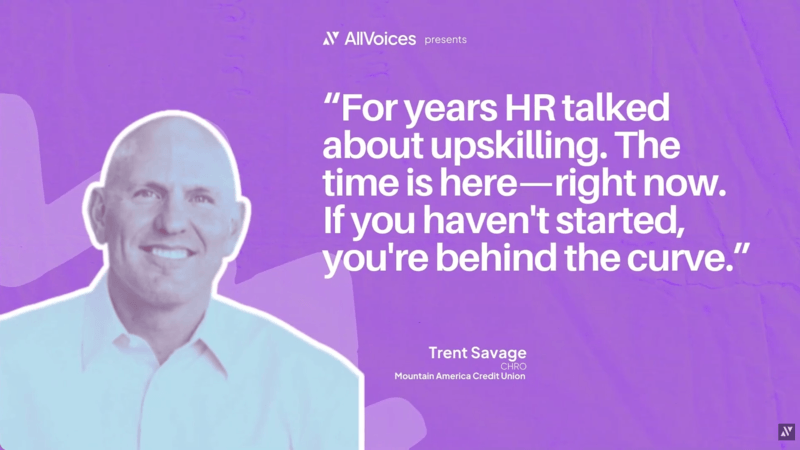
Mountain America Credit Union employs 3,700 people across five states, with two-thirds serving members on the front line. CHRO Trent Savage said growth from $8B to $22B in eight years forced a rethink of how work gets done. That pressure is increasing as retirements accelerate and the labor pool tightens.
Savage frames AI as the lever to absorb that strain through productivity. “There are huge opportunities with productivity savings,” he said, but only if AI is used intentionally. He warned many organizations are still in the “dabble phase,” which creates fear when leaders stay vague. Employees worry that AI will replace their jobs, so HR must overcommunicate the strategy and its impact before rumors spread.
His core tactic is making HR a full owner of the AI strategy. Savage said if the business is building AI plans, HR needs to be in those conversations. He views AI as a sociotechnical shift that requires balancing technology, culture, and trust, especially as agentic AI expands. On the workforce side, the time for upskilling is now. AI should automate transactional work and shift people toward problem-solving, collaboration, and leveraging technology.
The most concrete move is skills intelligence. Mountain America is building a skills ontology and using AI to benchmark internal roles against the external market, because skills data is fluid and constantly changing. The goal is transparency: showing employees which skills they are building, which roles fit them, and which skills they need next, all tied directly to learning. (link)
3) How to deploy AI agents safely without risking member trust

If an AI agent screws up in your back office, you learn. But if it screws up with a member, you lose trust. On an episode of C.U. On The Show, Doug English spoke with Velera’s Elizabeth Wadsworth about what comes next. “Agents are the next evolution of AI… moving from questions to completing tasks.” A copilot gives an answer. But an agent must be directed to do something.
Wadsworth recommends starting where mistakes don’t break member trust. The first agent use cases should land in back-office work, where tasks are repeatable and easier to control. To keep things safe, push governance before deployment. Responsible AI is a process built around transparency, accountability, fairness, privacy, explainability, and security. The practical test is explainability. If you cannot explain how a system works in one sentence, you’re not ready to run it. She also warns that bias can be hiding in your data, and even if a vendor is involved, the liability still sits with your Credit Union.
Here’s the easiest way to think about agents: Treat them like digital employees. You start with limited access, a narrow job, and earn more permissions over time. That approach lets you explore agents thoughtfully, without risking the trust your members already give you. (link)

Tips & Use Cases
Learn to apply AI…
3 AI adoption traps that could cost you members: Many Credit Unions rush into AI without fixing data, legacy systems, or member experience gaps, which amplifies friction. Focus on clean data, integrated systems, and self-service workflows first, or you risk losing younger members and deposits as $100T of Baby Boomer wealth gets inherited by younger generations over the next two decades. (link)
Affinity Plus Federal Credit Union reframes digital transformation as data-driven empathy: CIO Radha Chavali says AI only works when you break down silos and build a trusted “member plus outcomes” view, grounded in strong data governance before scaling use cases. Use member insights for just-in-time preapprovals, early risk detection before delinquency, and internal analytics to spot operational gaps, while investing in continuous upskilling so staff can act on what AI surfaces. (link)
AI-powered payments can help CUs win more SMB relationships: PayOnward CEO Cary Strange says AI should free your team from repetitive work so you can spend more time advising SMB members. Offering AI-based AR and bill pay with cash-flow forecasting lets you spot shortfalls weeks early and reach out with the right lending option. (link)
Glia’s voice AI playbook for faster Credit Union member service: Automate up to 60% of routine calls and chats with voice AI, then pass complex cases to staff with full context. With Glia, Azura CU cut wait times 50% and pushed abandonment below 1%, while Service First FCU saw a 21% lift in digital center loan dollars in H1 2025. (link)
Accenture warns AI agents could drain Credit Union income: As AI tools automatically compare rates and optimize cash, even loyal members will get nudged toward better offers, putting ~22% of pretax income at risk. Use genAI beyond cost-cutting to make proactive save offers, reprice faster, and approve interventions in real time before money moves outside your channels. (link)
Fraud is surging at Credit Unions as synthetic IDs mature: Alloy reports a 72% jump in fraud events in 2026, the steepest increase of any segment, driven by synthetic identities and rising in-branch schemes. Tighten onboarding with KYC waterfalls, add stronger synthetic ID checks, and use AI anomaly detection to catch slow-burning fraud without adding member friction. (link)
AI-ready modernization requires real-time checks across every channel: If your email, text, voice, and branch do not sync in real time, you remind members after they paid and you lose trust. Start with your top call drivers, get real-time data flowing, then use internal AI agent-assist and orchestration to cut decision cycles from weeks to seconds. (link)
Banks move away from OpenAI as AI strategies mature: Evident data shows OpenAI’s share of banking AI use cases fell from about half to one-third as banks adopt Anthropic and Google for performance and easier integration. (link)
Rezolve.ai shows how to build AI agents IT can actually govern and trust: Agents reason and use tools like employees, but without deterministic workflows, tool-level controls, and human-in-the-loop approvals, they’re too risky. Rezolve’s Agentic Studio adds workflows, tool controls, and human approvals to autonomous agents so Credit Unions can automate safely with full audit trails. (link)
Rezolve.ai shows multimodal AI handling real support work end to end: Rezolve.ai demoed one AI resolving voice calls, emails, Teams chats, and screenshots, completing password resets, creating tickets, and troubleshooting issues without handoffs. (link)
AI credit decisioning vendors help Credit Unions catch up to top banks: McKinsey says 20% of top banks already use genAI in credit risk, and 60% expect a use case within a year. Vendors like Zest AI and Upstart support AI-driven credit decisioning for CUs, while other platforms like Multimodal offer agentic workflows for regulated lending. (link)
If your AI can’t guide members, they’ll switch providers: McKinsey says over half of banking consumers already use genAI, and nearly all would leave if their bank does not keep up. Credit Unions must move AI beyond chatbots into predictive guidance and automated insights that help members make confident decisions during high-stakes financial moments. (link)
AI is becoming a finance “employee” that does the work: Personal agents already schedule calendars, draft invoices, summarize meetings, and keep conversations going on autopilot. For your finance team, start piloting an AI “employee” that holds context across FP&A tools and ERP, then executes repeatable workflows with human approval. (link)
AI is slowing bank hiring more than eliminating jobs: Fortune reports that despite AI fears and 2025 layoffs, banks are cutting fewer roles than expected and using AI to avoid hiring the next 100 employees. For Credit Unions, the signal is to deploy AI for productivity gains and capacity relief, not headcount reduction, while reskilling staff for higher-judgment work. (link)
AI is slowing bank hiring more than driving mass layoffs: Despite warnings, headcounts at JPMorgan Chase, Bank of America, and Goldman Sachs have stayed largely stable, as banks slow hiring. Experts say recent cuts reflect pandemic-era overhiring and economic uncertainty. Banks seek AI productivity so they don’t need to hire the “next 100 people.” (link)
Agentic AI emerges as the next inflection point for financial services: Leaders at the World Economic Forum say AI systems that can act autonomously could automate credit, fraud, compliance, and payments far beyond today’s genAI. (link)
Lloyds Banking Group reports £50M in genAI value in 2025: The value was delivered across service, engineering, search, and HR, with £100M+ expected in 2026 as usage scales. The bank is now training all 67,000 employees through an AI Academy, and preparing agentic AI and an in-app financial assistant. (link)
Standard Chartered launches AI platform for transaction banking teams: The new system automates knowledge search and solution tailoring so bankers spend less time hunting for information and more time advising clients. AI-driven knowledge hubs and recommendations speed proposals, personalize responses, and scale high-touch service. (link)
Bankwell invites peers to align on AI risk before it scales: Bankwell Bank convened a regtech summit with peer banks to pressure-test AI use cases, risks, and governance together. Leaders flagged data loss prevention, synthetic ID fraud, and explainability as top concerns. Bankwell already uses genAI to help vet small-business loans, and it’s evaluating AI to speed compliance reviews like BSA/AML with humans in the loop. (link)
AI flags forged signatures as check fraud stays stubbornly high: 63% of organizations faced check fraud in 2025, keeping signatures a major weak spot. AI tools from vendors like ParaScript can compare signatures against historical data and stop bad items before posting. (link)

Funding Spotlight
Where the money is flowing for innovation…
Sixfold raises $30M Series B to build an autonomous AI underwriter: The round scales agentic AI that plugs into existing P&C systems to automate underwriting across structured and unstructured data without changing workflows. (link)
WealthAi raises $800K pre-seed to build an AI-native OS for wealth managers: WealthAi is building an AI-driven operating system for advisers, family offices, and private banks that automates adviser workflows, unifies data, and reduces manual rekeying without replacing core systems. (link)
Datatruck raises Series A to build an AI-native TMS for real-time profitability: Datatruck is scaling an AI-first platform that embeds profit visibility into dispatch and documents, tracking margins by load, truck, and lane across 1,000+ companies and $1.7B+ in freight activity. (link)
Outtake raises $40M Series B to combat AI-driven impersonation: Outtake is scaling AI that detects and disrupts impersonation across text, image, and video, helping enterprises investigate identity-based threats faster and reduce takedown times as deepfake abuse accelerates. (link)
Rogo raises $75M Series C to expand agentic AI for finance teams: Rogo is scaling an end-to-end AI system that supports complex financial analysis and decision workflows, now used by 25,000+ finance professionals across banks and investment firms. (link)
HAQQ Legal AI raises $3M to build an AI operating system for legal work: HAQQ is expanding a vertically integrated platform that combines AI legal intelligence, practice management, payments, and jurisdiction-aware infrastructure into one system of record. (link)

Keeping up with Tech
The latest in fintech and tools…
New CUSO brings AI-driven balance-sheet analytics to Credit Unions: One Washington Financial launched a CUSO with Delfi Labs to give Credit Unions large-bank asset-liability modeling without large teams. Early adopter Maps Credit Union will use AI scenario analysis to make faster, clearer tradeoffs as rates and liquidity pressures shift. (link)
Google brings browser-level AI agents to Chrome: New Gemini-powered “auto browse” agents can navigate sites and complete multi-step tasks for users. For Credit Unions, assume AI will handle onboarding and product research, and plan stronger authentication, fraud controls, and agent-aware account protections. (link)
FICO and Tech Mahindra launch AI decisioning “Centre of Excellence”: The partnership aims to move AI decisioning to production by pairing FICO models with large-scale implementation support. The effort plans to reduce deployment risk, modernize legacy cores, and accelerate time-to-value. (link)
Fingerprint launches system to identify authorized AI agents on the web: The platform verifies signed AI agents from providers like OpenAI and Amazon Web Services, letting organizations allow trusted automation while blocking malicious bots. Credit Unions should plan for agent-aware controls, instead of banning all bots. (link)
AXA launches AI platform to guide financial advisors: Quest by AXA combines real-time macroeconomic data, market news, and proprietary research to help advisors deliver more consistent, insight-led financial and insurance advice without replacing the human relationship. (link)
OpenAI launches Codex app to orchestrate multiple AI agents: The new macOS app lets developers run, supervise, and coordinate multiple agents across long-running projects using isolated workspaces and reusable skills. (link)
OpenAI builds in-house AI data agent to speed internal decision-making: The internal agent lets employees query large datasets in natural language and receive validated, self-correcting insights in minutes by combining code-level context and institutional knowledge. (link)
Say adios to GPT-4o and older ChatGPT models as GPT-5.2 becomes standard: GPT-4o, GPT-4.1, GPT-4.1 mini, and o4-mini leave ChatGPT on Feb. 13, 2026, with no API changes. OpenAI is shifting focus to customization, personality controls, and tuning response behavior. (link)
OpenAI adds safeguards to stop AI agents from leaking data via URLs: Agentic browsing is now restricted to publicly observed links, while unverified URLs trigger warnings or require user action. The change reduces silent data exfiltration without breaking legitimate web tasks. (link)

In Other News
Related news you can learn from…
What banks expected in 2025 didn’t fully materialize (link)
AI agents get their own social network, chaos ensues (link)
Most AI vibe coding tools still don’t work for regular people (link)
Enterprise AI leaders are emerging, but the market is still in flux (link)
How Gemini could become a hands-on budgeting assistant in 2026 (link)
What Goldman and a16z see coming next for AI, capital, and growth (link)
Spacex merges with XAI to create a $1.25T AI-and-space powerhouse (link)
Credit Union leaders see 2026 as a turning point for AI, automation, and growth (link)

Community Corner
Memes and visuals…


Thanks for reading!
Until next week,
— Credit Union AI Guy
Enjoying this newsletter? Forward it to a colleague who might appreciate practical AI insights.
Have a question or want to share your own AI experiment? Reply to this email or connect with us on LinkedIn. We’re building a community of curious Credit Union professionals. Come join the conversation!